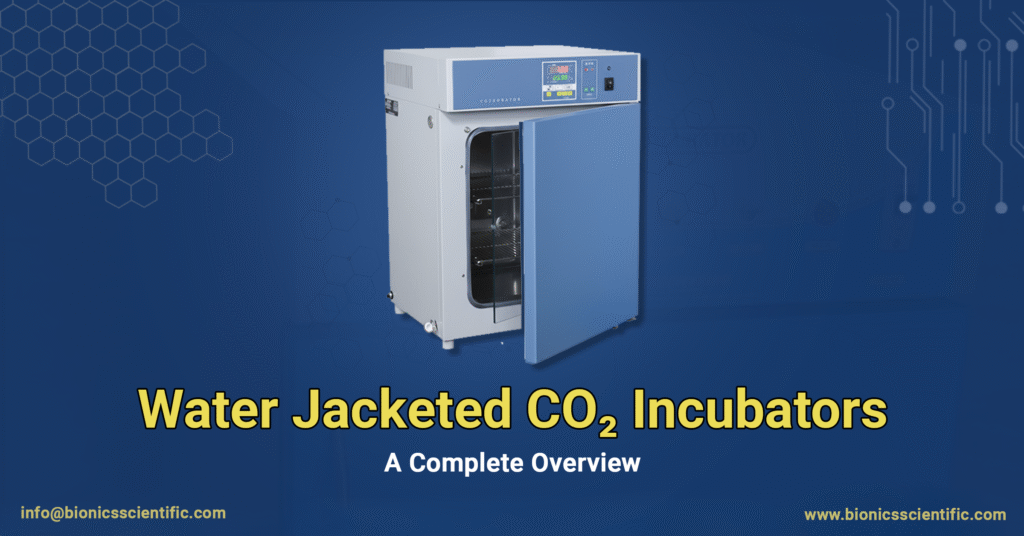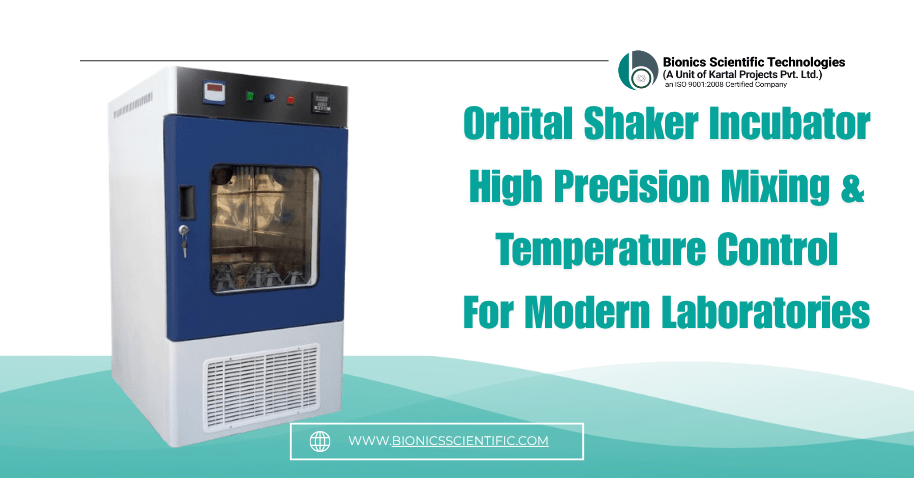

A laboratory incubator is a controlled chamber that keeps a steady temperature—and in some models, humidity or gas levels—allowing cultures, cell lines, or samples to grow under stable and repeatable conditions. The instrument is used in microbiology labs, pharmaceutical QC units, hospitals, diagnostic centers, food-testing facilities across India for daily work.
Purpose of an Incubator
The purpose of an incubator is to remove the surrounding environment as a variable. Room temperature shifts through the day, and biological processes are sensitive enough that this drift affects results if nothing compensates. An incubator compensates continuously, holding conditions near a set point.
How does an incubator work
A few components working together make this function possible.
Heating system: Heating elements provide controlled heat inside the chamber.
Temperature sensor: An RTD probe or thermocouple measures the chamber temperature.
Digital controller: Compares the measured temperature with the set point and controls the heating system.
Insulation: Helps reduce heat loss and maintain stable chamber conditions.
Air circulation: Natural convection or a fan helps distribute heat throughout the chamber.
Shelves: Perforated or wire shelves allow air to circulate around samples.
Humidity or gas control: Available in specific incubator types, such as CO₂ incubators, depending on the application.
Incubator Uses in Laboratory and Microbiology Work
Common incubator uses in laboratory settings include:
- Culturing bacteria, fungi, and yeast for identification
- BOD testing of water and effluent samples
- Sterility and stability testing in pharmaceutical QC
- Fermentation and enzyme studies
- Cell and tissue culture
- Microbial screening in food-testing labs
Incubators used in microbiology mainly involve identification, sensitivity testing, and studying growth behavior, all of which need the incubator in microbiology lab settings to hold its set point tightly.
Types of Incubators
Different labs need different designs. A bacteriological incubator for routine cultures has little in common with a CO₂ incubator running a live cell line.
Comparison of Laboratory Incubator Types
| Incubator Type | Main Control Parameter | Typical Applications | Key Benefit | Important Selection Consideration |
| Bacteriological incubator | Temperature | Routine culturing, diagnostics | Simple, reliable operation | Shelf uniformity |
| General-purpose laboratory incubator | Temperature | Academic, general research | Flexible use | The range fits all needs. |
| BOD incubator | Temperature, cooling | Water/wastewater BOD testing | Stable low-temperature control | Cooling and recovery speed |
| CO₂ incubator | Temperature, CO₂, humidity | Cell and tissue culture | Suits gas-sensitive cultures | CO₂ sensor accuracy |
| Shaking incubator | Temperature, agitation speed | Fermentation, suspension cultures | Growth plus mixing | Speed range, load capacity |
| Refrigerated incubator | Temperature, heating/cooling | Sub-ambient work | Wide operating range | Refrigeration reliability |
Incubator Temperature and Humidity
There is no single correct setting. Incubator temperature and humidity depend on the organism, sample, test method, and the lab’s approved SOP. A value used for one organism, given only as an example, may not suit another. Follow the validated method, not a general reference.
SOP of Incubator Operation
A practical SOP for incubator use includes the following:
- Inspect chamber, door seal and shelves
- Clean interior with a suitable disinfectant
- Set parameters per the validated method
- Load samples with spacing for airflow
- Monitor readings at set intervals
- Document settings and deviations
- Remove samples after incubation
- Clean the chamber again post-use
Follow your own documented SOP and applicable regulatory requirements for specifics.
Cleaning and Maintenance of the Incubator
Cleaning and preventative maintenance is critical for consistent incubator operation.
- Clean up spills as soon as possible.
- Use a cleaning solution that will not damage the chamber.
- Check the door seals.
- Keep the air vents free of obstruction.
- Do not overload the shelves.
- Check the sensors and alarms and over-temperature protection.
- Keep maintenance logs.
Laboratory Incubator Safety Precautions
The practice is safe for the users, samples, and equipment used.
- Avoid putting flammable or volatile substances into an incubator.
- Make sure to use the correct protective gear.
- Avoid blocking the air flow within the chamber.
- Check if there is a reliable electrical supply and earthing.
- Make sure that secondary containment of leaking samples is available.
- Make sure that alarms due to temperature are checked before running tests.
Incubator vs. Laboratory Oven
Although both instruments provide controlled heating, they are designed for different applications.
| Feature | Laboratory Incubator | Laboratory Oven |
| Primary purpose | Biological incubation | Drying and heating |
| Typical operation | Moderate controlled temperatures | Generally higher temperatures |
| Common samples | Cultures and biological samples | Glassware, materials and test samples |
| Important factor | Temperature stability and uniformity | Heating range and drying performance |
Exact operating ranges vary between models. Laboratories should check the manufacturer’s specifications and the applicable test method before selecting equipment.
Common Laboratory Incubator Problems and Troubleshooting
Laboratory incubator performance can be affected by incorrect loading, frequent door opening, blocked airflow, damaged seals, or sensor problems. The following checks may help identify common operating issues.
| Problem | Probable cause | Suggested testing procedure |
| Temperature variation | Repeated opening of the door or unsteady load | Minimize door openings and sample positioning. |
| Chamber temperature imbalance | Obstructed air flow or overloaded chamber | Ensure proper spacing between samples. |
| Temperature recovery is slow. | Overloaded chamber or a faulty door seal | Assess the load and the door seal |
| Condensation inside the chamber | High humidity or frequent temperature changes | Inspect the humidity and the door use |
| Inaccurate temperature measurement | Sensor drift or improper calibration | Schedule the calibration or technical assessment. |
If the problem continues, stop using the incubator for critical testing and contact qualified technical personnel.
Selecting an Incubator Instrument
When selecting a laboratory incubator, compare these factors based on your application and testing requirements:
- Application—microbiology, BOD, cell culture, or general use
- Chamber capacity—matched to real sample volume
- Temperature range — comfortably covers intended work
- Uniformity — even temperature across shelves
- Controller accuracy — consistent results run to run
- Recovery time — quick stabilisation after door opening
- Construction — durable build and good sealing
- Safety features — over-temperature protection
- Validation support — IQ/OQ/PQ documentation
- Service support — availability after purchase
View Laboratory Incubator Models & Specifications
Bionics Scientific manufactures laboratory incubators built around these considerations. Specifications are worth comparing against your specific application before purchase.
Why Bionics Scientific for a Laboratory Incubator?
Laboratory Incubators: Bionics Scientific offers laboratory incubators for microbiology, pharmaceutical, research, healthcare, food testing, and industrial applications. Available configurations can be selected based on chamber capacity, operating temperature range, controller requirements, and intended application.
Features available vary depending on the selected model and customer requirements:
- Changing volumes and temperatures of chambers
- Temperature control digital
- Robust chamber construction
- Safety protection of over temperature
- Application-based configuration options
- Installation & Technical Help
- Qualification documentation (if applicable)
Customers should verify the final specifications, documentation, and service requirements with Bionics Scientific before placing an order.
Contact Bionics Scientific
Laboratories, research organizations, pharmaceutical facilities, hospitals, diagnostic centers, educational institutions, and industrial facilities across India can contact Bionics Scientific with their application, chamber capacity, operating temperature range, and other requirements to receive product guidance and a quotation.
FAQ (Frequently Asked Questions)
What is the purpose of an incubator in the laboratory?
To maintain temperature control, sometimes humidity or CO₂ is for culturing microorganisms and running BOD or sterility tests or stability tests.
What is a laboratory incubator?
The insulation and air circulation allow the sensor and control system to regulate the heater as part of the feedback loop.
What temperature is used in a microbiology laboratory incubator?
It is contingent upon the organism and the method. Always follow the lab’s validated SOP.
What is the difference between a BOD incubator and a bacteriological incubator?
A bacteriological incubator is for general culturing, whereas a BOD incubator has cooling for low-temperature testing.
Does a laboratory incubator have a humidity control?
Some do – mainly CO₂ and specialist models. Standard units usually don’t.
What are the various types of laboratory incubators?
Bacteriological General Purpose BOD CO₂ Shaking and cold storage
What is the normal procedure for using an incubator?
Inspect, clean, set parameters, load samples, monitor, record, unload, and clean.
Which incubator is right for my laboratory?
Match your needs for application, capacity, temperature range, uniformity, accuracy, and safety.