Health starts from the ground up. Selecting the best soil for plant growth is one of the most crucial steps for gardeners, cultivators, scientists, and any agricultural research institute. The soil is not only used as a medium for roots, but it also provides the plant with water, nutrients, oxygen, and microbes needed during its growth process. With enough sunlight and water in place, any unhealthy condition of the soil can hinder the growth and productivity of the plants.
With the right composition of soil and proper nutrients and environment, the growth and productivity of plants can be enhanced. Here at Bionics Scientific, we provide assistance to universities and other research centers regarding plant growth chambers.
What Is the Best Soil for Plant Growth?
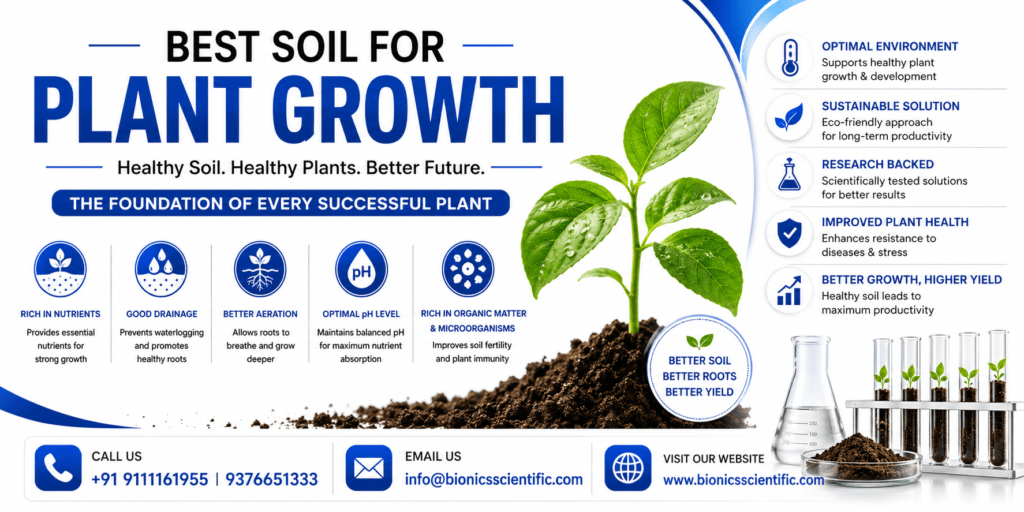
Loam soil is considered the best for plant growth. Loam soil is a blend of sand, silt, clay, and organic material. The type of soil has the perfect drainage along with high nutrient content where plants can easily extract water and nutrients as well as get adequate air for healthy growth.
A good soil must have:
- Good drainage but no waterlogging
- High content of organic material
- Good aeration for proper respiration of roots
- Soil pH between 6.0 and 7.0
- Macro and micronutrient balance
- Active microorganisms in the soil
All these attributes promote better root, foliage, flowering, fruiting, and yield.
Soil Types Comparison
| Soil Type | Benefits | Best Uses |
| Loamy Soil | Excellent nutrient retention, drainage, and aeration | Vegetables, fruits, herbs, flowers, research plants |
| Sandy Soil | Quick drainage and good airflow | Cactus, succulents, drought-resistant plants |
| Clay Soil | Rich in nutrients and moisture | Rice and water-loving crops |
| Silty Soil | Naturally fertile and moisture-retentive | Vegetables, cereals, ornamental plants |
| Peaty Soil | High organic matter and improved fertility | Horticulture, berries, ornamental plants |
Among these options, loamy soil remains the preferred choice because it offers the ideal balance required for sustainable plant growth.
Importance of Soil Fertility
Quality soil is essential in determining the health and well-being of plants since it provides nutrients to the plants, allows microorganism activities, stores water, and acts as a physical support structure for root development. The plants growing in soil that is rich in nutrients are generally healthier and resistant to diseases.
Some of the important nutrients necessary for growth include:
- Nitrogen (N)
- Phosphorus (P)
- Potassium (K)
- Calcium
- Magnesium
- Sulfur
- Iron
- Zinc
- Boron
- Manganese
By adding compost and organic manusoil’s fertility increases, along with the variety ofh the variety of the microorganisms and moisture content.
Growth and Development of Plants
Plant growth is an increase in size in plants due to cell division and elongation. The growth and development of the plants include all physiological, biochemical, and morphological changes taking place during the development of the plant from germination until its maturity.
Main stages of plant growth include:
- Seed Germination
- Seedling Development
- Vegetative Growth
- Flowering
- Pollination
- Fruit Development
- Seed Formation
- Maturation and Senescence
These stages require proper soil nutrients, water, sunlight, temperature, and other environmental conditions for their proper development.
Plant growth and development notes and plant growth and development NCERT PDF are
Plant Growth Hormones and Plant Growth Regulators
Development in plants is regulated by natural plant growth hormones, whereas plant growth regulators refer to natural or artificial substances used for controlling growth for farming and scientific purposes.
- The five main plant hormones are
- Auxins – Help in promoting root formation and stem elongation.
- Gibberellins assist in seed germination and stem growth.
- Cytokinins aid in cell division and delay leaf aging.
- Abscisic Acid (ABA): Helps in stress response and dormancy.
When asked to give an example of a plant hormone that stimulates growth, the answer should be auxin, which stimulates root formation and cell elongation.
Use of plant growth regulators is very common in agriculture, horticulture, greenhouse farming, tissue culture, forestry, and biotechnology to enhance the performance of crops.
Environmental Conditions for the Growth of Plants
Growth of healthy plants needs more than just fertile soils. Some of the environmental conditions that play a crucial role in the growth of the plants include:
- Temperature
- Intensity of light and photoperiod
- Humidity
- Availability of water
- Concentration of carbon dioxide
- Soil pH level
- Nutrients availability
Consistency in these parameters is essential for consistent and accurate experimental work.
In order to make an environment controlled for carrying out research on plants, plant growth chambers are utilized by researchers, in which all parameters, including temperature, humidity, lighting, and airflow, could easily be controlled.
Read More About Bionics Scientific Plant Growth Chambers:
Science Research and Reliable Source of Information
Contemporary agricultural practices are carried out with scientific research and reliable sources of information. As reported by the Food and Agriculture Organization (FAO), it is essential to have healthy soil for sustainable agriculture and environmental safety.
The Indian Council of Agricultural Research (ICAR) stresses the need for balanced soil nutrition, frequent soil analysis, and correct management of organic matter in order to ensure high yields.
The other sources include the results of research work available in the Journal of Plant Growth Regulation, which provides information about the field of plant physiology, biotechnology, molecular biology, plant stress response, plant hormones, and agricultural innovation. These reliable sources prove that the key factor of plant cultivation is appropriate soil.
Why go for Bionics Scientific?
One of India’s leading manufacturers of high-end lab and scientific instruments, Bionics Scientific produces plant growth chambers that enable universities, agricultural research institutions, biotech labs, pharmaceutical companies, and research organizations to carry out experiments in plant growth.
Our offerings include:
- Precise temperature and humidity control
- Uniform LED plant lighting
- Programmable environmental conditions
- Efficient energy consumption
- Custom-designed chambers
- PAN India installation and technical support services
Be it seed germination experiments, plant physiology, biotechnology, or crop improvement programs, Bionics Scientific offers reliable solutions according to your research needs.
Boost Your Plant Research With Bionics Scientific
Choosing the most suitable soil type for growing healthy plants is one of the initial steps towards their well-being. Still, having stable environmental conditions is also of equal significance when conducting scientific research.
At Bionics Scientific, we offer high-quality plant growth chambers tailored to serve agricultural research, biotechnology, educational establishments, the pharmaceutical industry, and environmental testing.
See our Plant Growth Chambers:
Need professional consultation?
Contact our technical experts today, and our team will help you choose the most suitable equipment according to your research requirements.
Frequently Asked Questions
What is the best soil for plant growth?
The best soil is loam soil because it has excellent drainage, nutrient retention, moisture retention, and aeration.
What is meant by plant growth regulators?
Plant growth regulators are natural or artificial chemicals that control rooting, blossoming, bearing of fruits, and the general growth of plants.
Name the plant hormone that stimulates growth.
The main plant hormone that controls root initiation, stem elongation, and proper plant growth is auxin.
Mention the stages of plant growth.
Germination of the seed, growth of the seedling, vegetative growth, flowering, pollination, fruit bearing, seed formation, and ripening.
Why are plant growth chambers important?
Plant growth chambers create an environmental control condition that increases accuracy and reliability of experiments carried out in the agriculture and biotechnology industries.