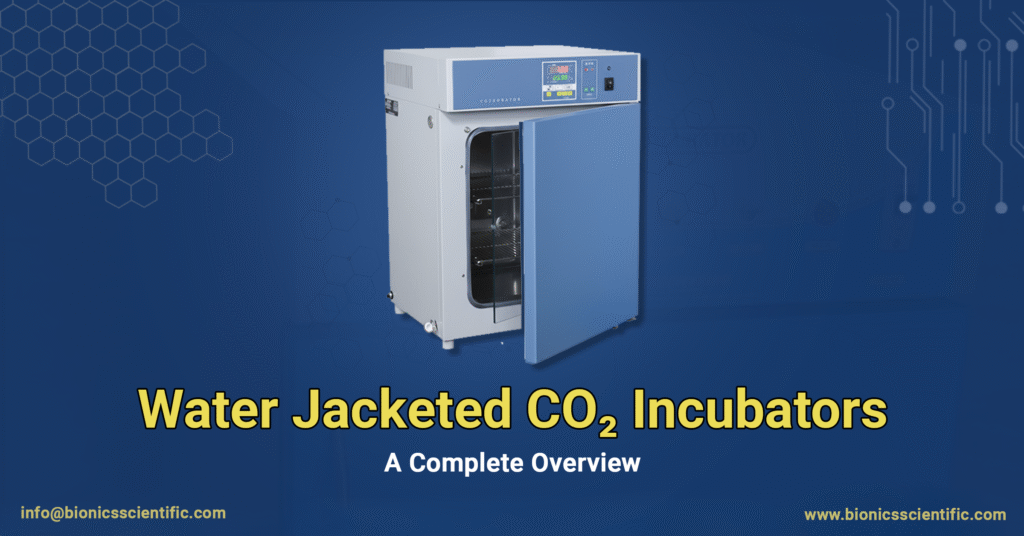

CO2 incubator selection requires careful comparison of sensor technology, contamination control, chamber capacity, operating costs, and service support. This guide explains the main factors Indian laboratories should check before purchasing a suitable model.
Quick Answer: The CO₂ incubator is used for maintaining a regulated temperature, CO₂ concentration, and humidity to create an ideal environment for cell and tissue culture. This equipment differs from the humidity test chamber because its main purpose is for testing various materials and products. The CO₂ incubator should be selected based on chamber volume, performance of sensors in intended conditions, recovery time, contamination prevention features, and so on.
Walk into almost any serious life sciences lab in India, and there’s one machine doing the heaviest, least glamorous work in the building—the CO₂ incubator. Nobody photographs it for the annual report. It doesn’t get the attention a confocal microscope gets. But ask any cell biologist what happens without it, and the answer is blunt: nothing. Cultures simply don’t survive long enough to be useful.
At Bionics Scientific, we’ve spent years in and out of labs across India—installing units, taking service calls at odd hours, and, more than once, figuring out why a lab’s cultures kept dying even though “the machine looked fine.” “One thing keeps happening. A CO₂ incubator isn’t lab furniture. It’s life support for your cells. Most people only realize this after they lose a batch. This guide exists so you don’t have to learn it that way.
What Is a CO₂ Incubator, Really?
A CO₂ incubator is an enclosed environment that is able to maintain controlled temperature, humidity, and CO₂ levels. Its main purpose is cultivation of mammalian cells and tissues, although some microorganisms can be grown in such an environment, as well. Requirements vary depending on the organism, cell line, and medium.
Here’s the part that trips up many first-time buyers: CO2 isn’t there just to be “biologically accurate.” It directly controls the pH of your culture medium through a bicarbonate buffer reaction. Let CO₂ drift even slightly, and your pH shifts with it—cells get stressed, growth slows, and sometimes an entire batch is quietly ruined without anyone noticing until it’s too late. That’s the real reason a genuine cell culture incubator is built around tight CO₂ control rather than treating it as a nice-to-have feature. If a machine can’t hold that line, nothing else about it matters much.
How It Actually Works — Reading the CO2 Incubator Diagram
Look at any CO₂ incubator diagram, and you’ll notice it’s not a complicated machine on paper. What matters is how well each part is executed, not how many parts there are.
| Component | What It Does | Question Worth Asking Before You Buy |
| Outer Chamber | Shields against room temperature swings | Does it hold steady through Indian summers and monsoon humidity? |
| Inner Stainless Chamber | Holds your cultures; fewer seams, less contamination | Is it genuinely seamless, or does grime collect in the joints? |
| CO₂ Sensor | Reads and corrects gas levels continuously | Is it an IR sensor or an older thermal type? How often does it drift? |
| Humidity System | Keeps media from evaporating | Does the water pan need topping up daily, or is it low-maintenance? |
| Heating Jacket | Keeps every shelf at the same temperature | How fast does it recover after someone opens the door? |
| HEPA Filter | Filters out airborne contaminants | How often does it need replacing, and what does that cost? |
| Control Panel | Displays readings, stores logs, triggers alarms | Does it actually log data, or just show a live number? |
CO₂ Incubator vs Humidity Test Chamber—Don’t Confuse These Two
This mix-up comes up constantly, and it’s an easy one to make since both machines “control conditions.” But they solve completely different problems.
| Parameter | CO₂ Incubator | Humidity Test Chamber |
| Built For | Living cell and tissue cultures | Stress-testing materials and products |
| CO₂ Regulation | Yes, tightly controlled | Not relevant |
| Who Uses It | Biology labs, IVF clinics, pharma R&D | Electronics, packaging, materials QA teams |
| Temperature Range | Fixed near 37°C | Wide—often -20°C to 150°C |
| Role of Humidity | Stops the media from drying out | The actual variable being tested |
| Field | Life sciences and healthcare | Manufacturing and industrial testing |
If your work is growing or sustaining live cultures, don’t let a similar spec sheet fool you—only a real cell incubator will actually keep your cells alive. A humidity test chamber, no matter how well built, isn’t designed for that job.
What Separates a Good CO₂ Incubator From One You’ll Regret Buying
Almost every buyer starts by comparing prices. Almost none of them are still thinking about price after a few failed batches—by then, reliability is the only thing that matters. Here’s what tends to actually decide that outcome:
| Feature | Why It Matters | What “Good” Looks Like |
| Sensor Type | “Drift” means bad data without warning | Infrared, not thermal conductivity |
| Contamination Control | This is the #1 reason buyers regret a purchase | High-heat decontamination, copper lining, or UV |
| Recovery Time | Every door opening is a small crisis for your cultures | Back to set point in under 10 minutes |
| Build Quality | Seams and rough surfaces harbor microbes | Seamless stainless steel interior |
| Data Logging | Needed for compliance, invaluable for troubleshooting | USB or cloud logs, real alarms |
| Power Resilience | India’s grid isn’t always kind to lab equipment | UPS-compatible, voltage-stable |
| After-Sales Support | Decides whether downtime is an hour or a week | Local technicians, fast response |
Here’s something we’ve seen repeatedly out in the field: the biggest cause of failed cultures usually isn’t a bad incubator—it’s neglected maintenance. We’ve walked into labs running a genuinely expensive unit that was underperforming for no better reason than a humidity pan nobody had cleaned in months or a door gasket that had quietly worn out. A solid CO₂ incubator will forgive small lapses. A great one paired with a team that actually understands upkeep has very few problems. Buyers who ask about training and support before signing off tend to have far fewer regrets a year in.
Why This Machine Is Non-Negotiable in a Modern Lab
India’s life sciences sector—IVF clinics, vaccine research, and diagnostic chains—has expanded fast, and a dependable cell incubator setup isn’t optional in that world anymore.
- Reproducible results—stable conditions mean your data can actually be trusted
- Fewer contamination losses — good filtration and lining cut failure rates meaningfully
- Less wasted time and reagent — every failed culture is money and weeks gone
- Compliance readiness—GLP, ss-GLP, GMP, and NABL accreditation often expect a validated unit, which matters even if you’re not there yet but plan to scale
- Room to grow—a well-built incubator supports stem cell work, embryology, and microbiology without needing a separate machine for each
Where CO₂ Incubators Actually Get Used
| Industry | What They’re Doing With It | What They Tend to Prioritize |
| Pharmaceutical R&D | Drug testing, cell-based assays | Logging, audit-readiness |
| IVF & Fertility Clinics | Embryo culture | Zero tolerance for fluctuation |
| Hospitals & Diagnostics | Tissue and microbiology work, part of the broader medical incubator setup | Easy cleaning, contamination control |
| Academic & Research Institutes | Stem cells, cancer, genetic research | Getting accuracy without blowing the budget |
| Biotech Companies | Vaccine and biologics development | Consistency across multiple units |
Why Labs Choose Bionics Scientific
We built Bionics Scientific on one idea: Indian labs deal with things that imported spec sheets don’t account for—voltage that isn’t always steady, humidity that swings hard between seasons, and the need for someone to actually pick up the phone when a machine acts up. Our CO₂ incubators are engineered with that reality in mind, not designed for a lab in a different climate and shipped here as an afterthought. Every unit comes with real installation support, calibration help, and a service team that’s actually reachable across the country — because what happens after you buy the machine matters just as much as the machine itself.
Ready to upgrade your lab’s culture environment?
Get in touch with Bionics Scientific today for a personalized CO₂ incubator recommendation, a live demo, or a quotation built around your lab’s actual needs.
Frequently Asked Questions
What is a CO₂ incubator used for?
It is primarily used to maintain mammalian cell and tissue cultures. It may also be used for certain microorganisms when their growth requirements match the incubator’s available temperature, humidity, and CO₂ conditions.
Why does CO₂ matter in a cell culture incubator?
It regulates the pH of the culture medium through a bicarbonate buffer system. Get the CO2 wrong, and the pH goes with it.
What’s the ideal CO₂ level?
Around 5% for most applications, though it can shift depending on the cell type and medium being used.
How is a CO₂ incubator different from a humidity test chamber?
One sustains living cultures biologically; the other stress tests materials industrially. Full breakdown is in the comparison table above.
How often should it be calibrated?
Every 3-6 months as a general rule, or per your lab’s own compliance schedule.
What usually causes contamination?
Poor cleaning habits, a neglected humidity pan, too many door openings, or missing HEPA/UV protection.
Can a CO₂ incubator be used for bacterial cultures?
Yes, this type of equipment can be used for some bacteria, especially those that thrive in high levels of CO₂. But not all bacteria cultures can do well in CO₂ incubators; rather, most of them would do better in a microbiological incubator.
What safety features actually matter in a medical incubator?
Over-temperature alarms, CO2 alerts, door-ajar warnings, and backup power compatibility.
How long does it take to stabilize after the door opens?
With a reliable IR sensor, it usually takes 5-10 minutes to return to the set point.
Why go with Bionics Scientific specifically?
Because the incubators are built for Indian lab conditions, and the support doesn’t disappear after the sale—installation, calibration, and servicing are all covered nationwide.
Looking for a CO2 incubator that’s actually built for Indian lab conditions — not just adapted to them? Talk to Bionics Scientific and get equipment that protects your research every single day.