Customers who compare different vacuum tray dryer manufacturers in India will find that more than a mere catalog model is required. Bionics Scientific produces vacuum tray dryers that can be used in various industries such as pharmaceuticals, chemicals, food processing, herbs, and laboratory testing, with the configuration depending on batch size and other factors. Customers need to consider certain features of the machines.
What is vacuum tray dryer ?
A vacuum tray dryer manufacturer in India removes moisture or residual solvent from a product by heating it inside a sealed chamber held under reduced pressure. That’s the key difference from a conventional atmospheric tray dryer, which relies on higher temperatures and moving air. Drop the pressure, and moisture starts evaporating at a noticeably lower temperature.
Many materials don’t hold up well under prolonged heat—they degrade, oxidize, or lose potency. Vacuum drying offers a gentler path to the same endpoint, which is why it shows up so often where product quality can’t be compromised.
How Does a Vacuum Tray Dryer Work?
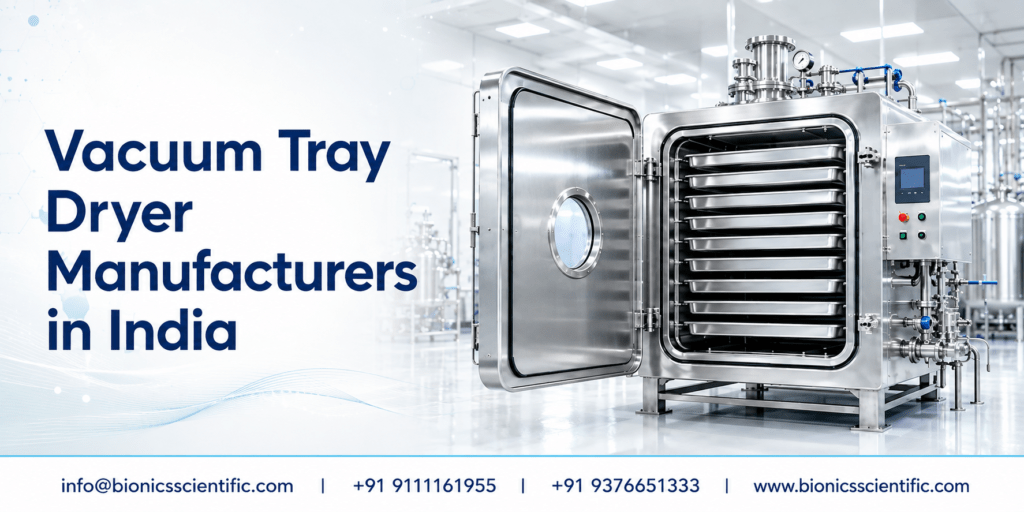
Material gets spread evenly across trays, which sit on heating shelves or platens inside a chamber built to hold vacuum. Once sealed, a vacuum pump pulls the internal pressure down, and that drop lowers the boiling point of whatever moisture or solvent is present.
Heat then moves from the shelves into the trays, causing evaporation at this reduced temperature. Vapours drawn out of the chamber are routed, depending on the application, through a condenser or receiver for collection or solvent recovery. Once the material hits its target moisture level, the vacuum is broken and the product is unloaded.
Drying temperature, vacuum level, and cycle time all shift with the product’s own characteristics—there’s no single figure that applies across the board.
When Is Vacuum Drying Suitable?
Which Products Benefit Most From Vacuum Drying?
This method tends to come up for heat-sensitive and oxidation-sensitive materials, hygroscopic products, and anything high-value where losing yield to a harsh drying process isn’t acceptable. It’s a natural fit wherever drying conditions need to stay tightly controlled. Materials containing a recoverable solvent can be processed this way too, though that calls for a proper process and safety review first.
Whether industrial vacuum tray dryer is the right choice depends on the product’s thermal behavior, the solvent or moisture properties involved, batch conditions, and the final moisture level the buyer is aiming for.
Components and Configuration Options
A vacuum tray dryer manufacturers in India is built around a vacuum-tight chamber, heating shelves or platens, and product trays sized and counted to match the batch. The vacuum pump and heating system are chosen based on the vacuum level and process required, and where solvent recovery matters, a condenser or receiver is added.
Beyond that, there are temperature and vacuum drying equipment manufacturers, valves, pipelines, gaskets, and safety provisions. Stainless-steel grades are usually specified separately for product-contact surfaces versus structural, non-contact parts, and internal finishes are chosen to suit the material. Controls range from fully manual to semi-automatic to application-specific—the right combination is a conversation to have with the manufacturer.
Typical Configuration Parameters to Discuss With a Manufacturer
Because a vacuum tray dryer supplier is engineered around the product rather than sold as an off-the-shelf unit, the table below lays out what buyers should expect to work through with the manufacturer — not universal numbers for every project.
| Parameter | What It Depends On |
| Chamber and shelf size | Batch volume, tray count, and available floor space |
| Number of trays | Batch size, bulk density, and required throughput |
| Vacuum level | The product’s boiling-point behaviour and solvent properties |
| Heating medium | Utility available on site — steam, hot water, thermic fluid, or electric |
| Material of construction | Product compatibility, hygiene needs, and regulatory requirements |
| Internal surface finish | Product sensitivity and cleaning or validation requirements |
| Condenser or solvent recovery | Whether the process involves a solvent worth recovering |
| Instrumentation and controls | How critical the process is, GMP needs, and automation preferences |
| Safety provisions | Hazardous-area classification and material handling risk |
These get finalized jointly after the manufacturer has actually reviewed the material and process—not applied regardless of application.
Industrial Applications
Vacuum tray dryers show up across a fairly wide spread of industries, though the right design isn’t the same from one to the next. In pharmaceuticals, controlled drying supports product stability and compliance with applicable pharmaceutical manufacturing regulations. In chemicals, solvent recovery and oxidation control tend to be bigger concerns. Food processing brings in heat-sensitive ingredients, while nutraceuticals and herbal or botanical extracts rely on gentler drying to protect potency.
Vacuum tray dryers are also suitable for use in the preparation of cosmetics, pigments, and chemical intermediates when high temperature and uneven drying will be detrimental to further processing steps. There are different types of vacuum tray dryers that can be used depending on the requirements of the application being considered.
How Buyers Should Compare Manufacturers
What Should Buyers Check Before Finalizing a Vendor?
Comparing vacuum tray dryer manufacturers in India shouldn’t start and end with price. Check whether the manufacturer takes time to understand your process, how they approach chamber and shelf design, how they select the vacuum drying equipment manufacturer system, and what material of construction they’re proposing.
Comparison Checklist for Evaluating Vacuum Tray Dryer Manufacturers
| Evaluation Area | What to Look For |
| Process understanding | Willingness to review material behaviour before proposing a design |
| Design and engineering | Chamber, shelf, and vacuum-system design suited to the application |
| Material and finish | Correct stainless-steel grade and surface finish for the product |
| Build quality | Workmanship, weld quality, and temperature uniformity across trays |
| Controls and instrumentation | Reliable monitoring, with GMP-compliant options where required |
| Maintenance access | Ease of cleaning, tray loading, and routine servicing |
| Safety compliance | Provisions matched to the product and installation environment |
| Documentation | Availability of drawings, manuals, and validation support |
| Installation support | Guidance on commissioning at the buyer’s site |
| After-sales service | Spare-parts availability and responsiveness post-installation |
| Export capability | Experience coordinating packing and shipping for overseas orders |
A checklist like this, rather than the lowest number on a quotation, is what protects buyers from a dryer that looks fine on paper but doesn’t hold up in production.
Factors Affecting Vacuum Tray Dryer Price
What Determines Vacuum Tray Dryer Price in India?
Price isn’t tied to one specification—it moves with batch capacity, tray number and size, material of construction, chamber design, heating medium, operating conditions, and vacuum pump selection. On top of that, whether a condenser or solvent-recovery system is needed, automation level, instrumentation complexity, safety provisions, documentation and validation requirements, custom engineering, installation, and export packaging all feed into the final number.
Given how many variables are in play, it makes more sense to compare scope of supply, construction quality, utility requirements, realistic performance expectations, service support, and lifecycle cost—rather than picking a vendor purely because their quotation is the lowest on the table.
Information Required for Correct Selection
Buyers must give details such as the name of the product, batch weight, bulk density, moisture levels at both initial and final stages, heat stability, drying temperature, information about solvents to be used, and estimated time for completion of the process. The manufacturer must inform the choice of material to use, heating utility available, site of installation, and place of delivery.
Why Choose Us as Your Vacuum Tray Dryer Manufacturers in India? Bionics Scientific Technologies
Bionics Scientific produces vacuum tray dryers in standard sizes of 6, 12, 18, 24, 36, 48, and 96 trays. Available construction options may be mild steel, SS 304, SS 316, and SS 316L as per application and product-contact needs. The equipment is equipped with hollow pad heater trays, food-grade stainless steel trays, temperature control using PID, and vacuum level monitoring.
Options to be discussed by the buyers based on application include PLC control, vacuum pump, nitrogen purging system, validation point, shell & tube condenser, condensate receiver, and circulating system. Customized design as per product property, capacity requirement, operating temperature, heating utility, and regulatory compliance can be considered by the company.
The vacuum tray dryers produced by the company are meant for laboratory, pilot-scale, and manufacturing-scale applications of pharmaceutical, chemical, food, herbal, and cosmetic processing. The equipment can be procured by buyers based in India and other countries from the company.
Frequently Asked Questions
What is a vacuum tray dryer?
A batch drying system that removes moisture or solvent from a material by heating it in trays inside a sealed chamber under reduced pressure, letting evaporation happen at a lower temperature than atmospheric drying.
How does a vacuum tray dryer work?
Material on trays goes into a sealed chamber; a vacuum pump brings the pressure down; heating shelves supply heat; moisture evaporates at that reduced temperature; and vapors are extracted—often through a condenser.
Which materials can be processed in a vacuum tray dryer?
Heat-sensitive, oxidation-sensitive, and hygroscopic materials across pharmaceuticals, chemicals, food, nutraceuticals, herbal extracts, and cosmetics, though each case still needs its own assessment.
Why is vacuum drying favorable for heat-sensitive products?
The process of vacuum drying helps in decreasing the boiling temperature of moisture or solvent; hence, it makes the heat-sensitive products dry under relatively low temperatures.
How can we determine the capacity of a vacuum tray dryer?
By taking into consideration various factors such as batch size, density of material, load on tray, etc.
Which is the most suitable material for manufacturing a vacuum tray dryer?
It depends upon factors like chemical compatibility, hygienic conditions, and regulation compliance, and most often, the materials used in making the product contact parts and non-product contact parts are decided separately.
What is the basis of pricing for vacuum tray dryers in India?
Capacity, materials of construction, chamber design, vacuum pump choice, automation degree, instrumentation, safety measures, documentation, and export packaging.
Can a vacuum tray dryer be customized for pharmaceutical or chemical processing?
Yes—chamber design, control systems, material of construction, and solvent-recovery provisions can all be adapted to process and compliance requirements.
What data should be known for an exact quotation?
Name of the product, batch volume, moisture content, temperature-sensitive nature, drying temperature, type of construction, location where it is installed, and destination country.
Does Bionics Scientific deal with queries from all over India and abroad?
Yes, Bionics Scientific deals with customers all over India and abroad.
Vacuum tray dryer planning underway?
Get in touch with Bionics Scientific for evaluation and a quotation. Provide us with the properties of the materials being dried, batch sizes, starting and ending moisture contents, heating medium, desired construction, any regulatory considerations, installation location, and destination nation so we can help you choose an appropriate configuration.