Quick Answer
A vertical laminar air flow (VLAF) unit is a contamination-control workstation that pushes HEPA-filtered air downward, in unidirectional parallel streams, to protect samples, products, or processes from airborne particles. It is used across pharmaceutical, hospital, IVF, microbiology, and electronics environments wherever ISO Class 5 (Class 100) conditions are required. Unlike a biosafety cabinet, a standard vertical LAF protects only the product, not the operator—which is why the choice between a laminar airflow hood and a biosafety cabinet Class II Type A2 unit depends on what needs protecting.
What Is Vertical Laminar Air Flow?
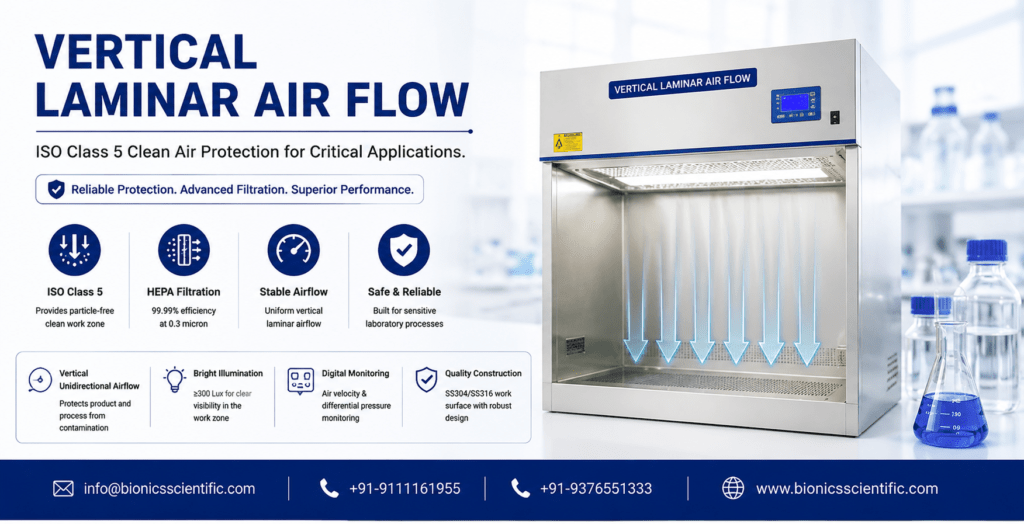
Air is drawn through a pre-filter and a HEPA (or ULPA) filter mounted at the top of the enclosure, then discharged downward across the work surface in parallel, non-turbulent streams. Because the airflow moves in one direction without mixing, particles are continuously swept down and out through the front or base grille rather than recirculating over the product. This unidirectional pattern separates true laminar flow from a simple filtered-air enclosure, where turbulence allows particles to re-enter the clean zone.
Manufacturer-specified HEPA filters typically carry 99.99% efficiency at 0.3 microns (H14 grade), and the work zone is commonly validated to ISO Class 5 under ISO 14644-1, which is equivalent to the older “Class 100” designation. Actual particle counts, velocity, and recovery time should be confirmed against the unit’s own validation report, since filter loading, geometry, and blower configuration all affect real performance.
Application of Laminar Air Flow
- Pharmaceutical manufacturing — sterile filling, compounding, and dispensing of injectables
- Hospital and clinical labs — media preparation, IVF embryology work, reagent handling
- Microbiology and QC labs — plating, culture transfer, sample prep
- Electronics and precision assembly — particle-sensitive component handling
- Tissue culture and biotechnology — plant tissue culture, cell line propagation
Vertical airflow lets gravity assist particle removal, and operators at the front of the unit are less likely to disturb the airflow curtain than with a horizontal configuration, where air blows directly toward them.
Laminar Air Flow vs. Related Clean-Air Equipment
- Biosafety cabinet (Class II, Type A2) — protects the operator, product, and environment simultaneously using inflow air barriers and HEPA-filtered exhaust; required for biohazardous materials. This is a fundamentally different risk category than a laminar airflow hood, which offers no personnel protection.
- Air shower — a decontamination chamber at cleanroom entry points that blasts high-velocity filtered air to remove surface particulates before entry; not a workstation.
- Sampling booth — a controlled enclosure for weighing or sampling raw materials, combining downflow air with local exhaust to contain dust or powder.
- Dispensing booth — used for powder or liquid dispensing, with a vertical downflow curtain plus rear or base extraction to capture particulates at the source.
Buyers often shortlist a LAF hood, a biosafety cabinet, and a dispensing booth for the same project before realizing they solve different problems—matching equipment to the actual hazard avoids costly reselection later.
Biosafety Cabinet Types (Quick Reference)
- Class I — protects operator and environment only, no product protection
- Class II Type A1/A2 — protects operator, product, and environment; A2 suits minute quantities of volatile chemicals/radionuclides
- Class II Type B1/B2 — higher containment, hard-ducted exhaust, for more hazardous work
- Class III — maximum containment, gas-tight, glovebox-style, for highest-risk agents
Parts of Laminar Air Flow / Biosafety Cabinet Parts
- Pre-filter — captures coarse particulate, extends HEPA filter life
- HEPA/ULPA filter bank — primary particulate barrier, ~99.99% efficient at 0.3 microns
- Blower/motor assembly — maintains constant, manufacturer-specified airflow velocity
- Plenum chamber — distributes air evenly before it reaches the filter
- Work surface (SS304/SS316) — non-shedding, corrosion-resistant, easy to sanitize
- UV germicidal lamp — pre/post-operation decontamination, interlocked with access panel
- Digital airflow velocity & differential pressure gauge — monitors filter loading in real time
- Front sash/access panel — defines the inflow air barrier on biosafety cabinets; absent on open-front LAF hoods
- Base/exhaust grille — channels used air out, completing the unidirectional path
Specification Table (Typical Vertical LAF Unit)
| Parameter | Typical Specification |
| Airflow direction | Vertical (top-to-bottom) |
| Filter efficiency | 99.99% @ 0.3 microns (H14 HEPA) |
| Cleanliness class | ISO Class 5 (Class 100) |
| Average airflow velocity | 0.45–0.55 m/s (confirm per model) |
| Work zone illumination | ≥300 lux |
| Noise level | ≤65 dB(A) |
| Construction | Powder-coated MS body; SS304/SS316 surface |
| Sash/viewing panel | Toughened safety glass (model-dependent) |
| UV lamp | Optional, interlocked germicidal UV-C |
| Power supply | 220–240V, 50 Hz single phase; export configurable |
Temperature & Airflow Stability Reference
| Monitoring Point | Ambient Reference | Observed Range |
| Work zone temperature | 22–25°C ambient | ±2°C of ambient (no active heating/cooling) |
| Filter face velocity uniformity | Center point baseline | Within ±20% per ISO 14644-1 |
| Recovery after door/access disturbance | — | Manufacturer-specified per validation |
A vertical LAF unit filters and directs air — it does not regulate temperature. Where temperature control is required, specify it as a separate add-on or via room-level HVAC.
Why Specification and Sourcing Matter
Bionics Scientific has manufactured laboratory and cleanroom equipment for 35 years, with vertical and horizontal laminar airflow units among 18,000+ pieces supplied pan-India and to export markets. Manufacturing is certified to ISO 9001:2015 and GMP, with CE marking under the MDD framework, the certification scope covers cleanroom equipment and biosafety cabinets—verifiable with the issuing body.
For buyers in the Middle East, Saudi Arabia, the US, and Oman, as well as pan-India, the sourcing priority is the same: validated filter performance, spare-parts availability, and IQ/OQ documentation that satisfies local regulatory inspection.
Get a Specification Sheet or Quote
Share your cleanliness class requirement, work zone size, and regulatory framework (WHO-GMP, USFDA, and local pharma board), and Bionics Scientific’s technical team can recommend a configuration and provide validation documentation, spec sheets, and export-ready quotations for Middle East, Saudi Arabia, US, Oman, and pan-India delivery.
[Request a Quote →] [Download Spec Sheet →] [Talk to a Technical Specialist →]
Frequently Asked Questions
What is the difference between vertical and horizontal laminar air flow?
Vertical LAF directs air downward onto the work surface; horizontal LAF pushes air from the back toward the operator. Vertical is generally preferred for gravity-assisted particle removal.
Does a laminar airflow hood protect the operator?
No — it protects only the product. Operator protection requires a biosafety cabinet with an inflow air barrier, such as a Class II Type A2 unit.
What is Class II Type A2 biosafety cabinet?
Product protection, personal safety, and environmental safety at once with around 70% internal recirculation of HEPA-filtered air, the rest being exhausted.
What is ISO cleanliness class of vertical laminar airflow hood?
Usually ISO Class 5 (“Class 100”), depending on installation-specific particle count test validation.
How often should HEPA filters be replaced?
Depends on usage and differential pressure readings; replace when pressure drop or velocity falls outside the validated range, not on a fixed schedule.
What’s the difference between a sampling booth and a dispensing booth?
A sampling booth is for controlled weighing/sample extraction; a dispensing booth handles powder or liquid transfer with stronger local extraction.
What is an air shower, and how does it differ from an LAF hood?
A decontamination chamber at a cleanroom entrance that removes surface particles before entry — an entry-control device, not a workstation.
Can vertical LAF be used for sterile pharmaceutical dispensing?
Yes, provided the validated cleanliness class and airflow parameters match the regulatory requirement.
Is UV sterilization included in a laminar airflow hood?
Often supplied as an interlocked add-on for surface decontamination, it is not a substitute for HEPA filtration.
What certifications should buyers check?
ISO 9001, GMP compliance, and CE marking where applicable, plus model-specific IQ/OQ and particle count validation reports.
Bionics Scientific—35 years manufacturing lab and cleanroom equipment, 18,000+ pieces supplied pan-India, exporting to the Middle East, Saudi Arabia, the USA, and Oman.