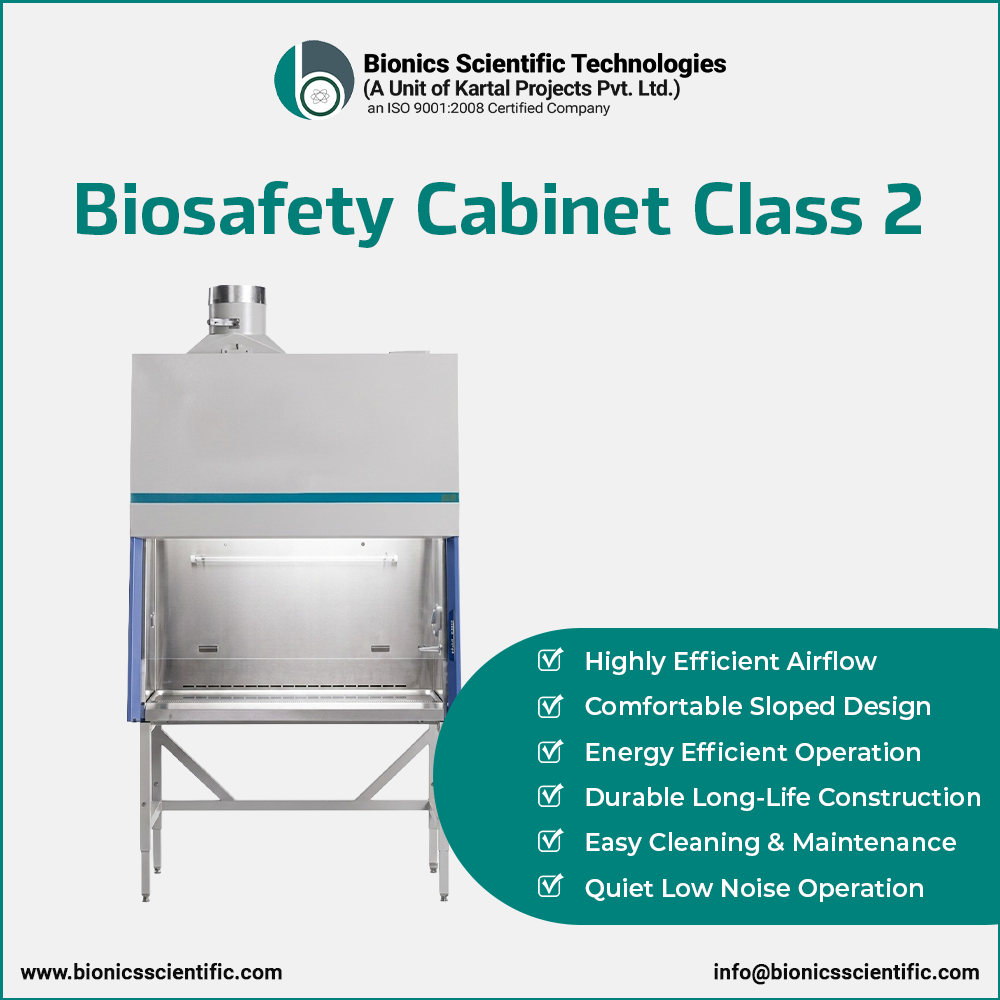
Biosafety Cabinet Class 2 Manufacturer in India
Class 2 Biological Safety Cabinets: Type A2, B1 and B2
A Class II biosafety cabinet is a ventilated, HEPA-filtered enclosure that protects the operator, the work and the laboratory when you handle biological material. Air is drawn in at the front to protect you, filtered air flows down over the work to protect your samples, and the air leaving the cabinet passes through a HEPA filter to protect the room.
Bionics Scientific is a Biosafety Cabinet Class 2 manufacturer in India, offering Type A2, B1 and B2 cabinets for microbiological, pharmaceutical, clinical and research laboratories. We have been manufacturing laboratory and cleanroom equipment in India for 26 years.
Biosafety Cabinet Class 2 is designed to protect the operator, product and laboratory environment during microbiological, pharmaceutical, clinical and research applications. These Biosafety Cabinets are used to contain low-to-moderate risk biohazardous materials. They have downward airflow and HEPA filters that re-circulate air, providing the required level of protection from microorganisms and aerosols. They are widely used in drug preparation, chemotherapy preparation, clinical research, medical and pharmaceutical work, and life science and industrial laboratories, so the cabinet you choose must meet the standards that apply to your application.
Class 2 Biosafety Cabinet at a Glance
- Types: Class II Type A2, B1 and B2
- Sizes: 3, 4, 5 and 6 ft (a 2 ft size is also listed in the dimensions table)
- Inflow / downflow velocity: 105 fpm (0.53 m/s) / 60 fpm (0.30 m/s)
- Filter: HEPA, 99.999% efficient (ULPA optional)
- Noise level: below 65 dBA
- Lighting: fluorescent, 90–120 foot-candles
- Controller: microprocessor with digital display
- Front door: frameless auto sliding glass door
- Certification: NSF/ANSI 49 (optional)
Different Names, Same Purpose
A biosafety cabinet goes by several names in the research industry. Microbiological safety cabinet, biological safety cabinet (BSC) and biosafety hood are the common ones, and microbiologists use them interchangeably. A biosafety hood is not the same thing as a chemical fume hood, which is covered in the comparison below.
How a Class II Biosafety Cabinet Protects You
- Operator protection: room air is drawn in through the front opening, so aerosols from your work are not pushed toward you.
- Product protection: HEPA-filtered air flows downward over the work surface, keeping your samples clean.
- Environmental protection: air leaving the cabinet passes through a HEPA filter before it is released.
These protections only work if the cabinet is used correctly and its airflow is certified, so the sections on use and certification below matter as much as the cabinet itself.
Types of Class 2 Biosafety Cabinet
To meet varying research and clinical needs, biosafety cabinets are designed mostly in three types: Type A2, Type B1 and Type B2. When a cabinet is used correctly, all three protect the operator, the sample and the environment, and they are tested against the same pass and fail criteria. The CDC and NIH publish BMBL biosafety guidance that laboratories use to choose and use these cabinets.
How Do We Differentiate Each Class 2 Biosafety Cabinet?
Each biosafety cabinet is differentiated by the amount of air re-circulation, how air is exhausted, and the pressure arrangement. Before buying one, you should know the basic differences between these three types:
- Biosafety Cabinet Class 2 Type A2: approximately 70% of the HEPA-filtered air is circulated through the cabinet, while 30% passes through an exhaust HEPA filter and is discharged.
- Biosafety Cabinet Class 2 Type B1: this Class II BSC exhausts 60% – 70% of the HEPA-filtered air, while 30% – 40% is re-circulated inside the workspace through a HEPA filter.
- Biosafety Cabinet Class 2 Type B2: a total exhaust BSC with no re-circulation inside the workspace. The blower exhausts 100% of the filtered air.
| Point | Type A2 | Type B1 | Type B2 |
|---|---|---|---|
| Air recirculated in the workspace | About 70% | About 30–40% | None |
| Air exhausted | About 30% | About 60–70% | 100% |
| Best suited to | Most microbiology and cell culture work without volatile chemicals | Work with small amounts of volatile chemicals, where a ducted cabinet is needed | Work involving volatile toxic chemicals |
| Exhaust arrangement | Can be connected to a duct or released through a HEPA filter, depending on installation | Ducted to the outside | Ducted to the outside |
Chemical use is the main reason to move away from Type A2. Check the BMBL guidance and your risk assessment before you decide, and tell us what you plan to handle.
Which Type Should You Choose?
- Choose Type A2 for routine microbiology, tissue culture and most clinical and research work that does not involve volatile toxic chemicals.
- Choose Type B2 if you will work with volatile toxic chemicals, since all the air is exhausted.
- Type B1 sits between the two and suits some mixed workloads.
- If you prepare hazardous drugs such as cytotoxic medicines, ask us which cabinet and exhaust arrangement your procedure calls for.
Class I, Class II and Class III Biosafety Cabinets Compared
| Class | What it protects | How it works |
|---|---|---|
| Class I | Operator and environment, but not the sample | Room air is drawn in across the work, and exhaust air is HEPA filtered |
| Class II | Operator, sample and environment | Inflow at the front, HEPA-filtered downflow over the work, HEPA-filtered exhaust |
| Class III | Highest level of containment | A gas-tight enclosure, worked through attached gloves, for the most dangerous agents |
This page covers Class 2 cabinets. If you need a Class I or Class III cabinet, contact us with your requirement.
Which Biosafety Levels Is a Class II Cabinet Used For?
Class II cabinets are commonly used for work with agents at biosafety levels 1, 2 and 3. Your own risk assessment and the BMBL guidance decide the containment you need, not the cabinet alone.
Biosafety Cabinet vs Laminar Air Flow Cabinet vs Fume Hood
These three are often confused, but they do different jobs.
| Equipment | Protects | Use it for |
|---|---|---|
| Biosafety cabinet (Class II) | Operator, sample and environment | Biological material, including infectious agents |
| Laminar air flow cabinet | The sample only | Clean work with non-hazardous material. A horizontal unit blows air toward the user, so it is not for infectious material |
| Laboratory fume hood | The operator from chemical fumes | Chemical work. It has no HEPA filtration to protect the product |
Customized Class II Biological Safety Cabinets
Bionics Scientific manufactures biosafety cabinets that are built to follow the European Standard EN 12469 and NSF standards, and NSF/ANSI 49 certification is listed as an option. Please confirm the certification for your model in the quotation. Our cabinets are available in four sizes (3 ft, 4 ft, 5 ft and 6 ft), as a ducted or recirculating type, and there are design options and accessories to suit most applications. Each cabinet is factory tested before it ships.
Features of Biosafety Cabinets
| Class 5 conditions (class 100) per ISO 14644-1 and 2 | 10° sloped front for comfortable working |
| Produces less heat and energy efficient | Highly efficient airflow management system |
| Lighting through fluorescent lamp | Filters can be changed easily from the front side |
| Durable construction for long service life | Durable wall plenum design |
| Easy to clean and maintain | Powder coated MS exterior |
| Low noise operation | Audio / visual sash alarm |
Standard Sizes (Dimensions)
| Nominal Size | 2 ft. | 3 ft. | 4 ft. | 5 ft. | 6 ft. |
| Working area (ft.) | 2 x 2 x 2 | 3 x 2 x 2 | 4 x 2 x 2 | 5 x 2 x 2 | 6 x 2 x 2 |
| External size (ft.) | 2 x 3 x 7 | 3 x 3 x 7 | 4 x 3 x 7 | 5 x 3 x 7 | 6 x 3 x 7 |
Biosafety Cabinet Specifications
| Inflow Velocity | 105 fpm (.53 m/s) |
| Downflow Velocity | 60 fpm (0.30 m/s) |
| Noise Level | <65 dba |
| Filter | HEPA filter 99.999% efficient (ULPA - Optional) |
| Particle retention | 0.3 microns |
| Light | Fluorescent light |
| Light Intensity | 90 - 120 foot-candles |
| Controller | Microprocessor controller w/ digital display |
| Body Construction | Wooden / PCRC Sheet / SS 304 / SS 316 |
| Table Construction | Stainless Steel 304 |
| Front Door | Frameless auto sliding glass door |
| Pressure Gauge | Magnehelic gauge |
| Blower assembly | 1/3 HP, Single Phase, 1440 RPM motor, Capacity 1000 CFM, Pressure 30 mm WG |
| Exhaust assembly | 300 CFM, ducting by PVC pipe with rain guard - Dia. 150mm |
| Certifications | NSF/ANSI 49 (Optional) |
| Optional | - Raised airflow grill - Spare UV lamp - Vacuum Tap - Exhaust (LH / RH / Top) |
Standard & Optional Accessories
 |
 |
 |
| Stainless Steel Casters | Telescoping Base Stand | Magnehelic Gauge |
 |
 |
 |
| Thermal Anemometer | Service Fixtures | UV Lamp |
How to Choose a Biosafety Cabinet
- What you will handle: biological material only, or also volatile chemicals? This decides between Type A2 and Type B2.
- How many people work at once: a 3 or 4 ft cabinet commonly suits one operator, while 5 and 6 ft cabinets give room for two.
- Exhaust arrangement: recirculating or ducted, and which side the exhaust should leave from (left, right or top).
- Body material: choose from the construction options in the specification table to suit your cleaning and disinfection routine.
- Accessories: a telescoping base stand, vacuum tap, spare UV lamp or raised airflow grill.
- Certification: say early if you need NSF/ANSI 49 certification.
- Site: allow for the external size, which is about 7 ft tall, and for ducting if you choose a ducted cabinet.
Using a Biosafety Cabinet Correctly
- Switch the cabinet on and let it run for a few minutes before you start work, and again after you finish.
- Place everything you need inside before you begin, so you are not moving your arms in and out.
- Do not block the front or rear air grilles with equipment or paper.
- Move slowly and keep movement inside the cabinet to a minimum, because fast movement disturbs the air barrier.
- Avoid open flames. They disturb the airflow and can damage the HEPA filter.
- Disinfect the work surface before and after use. A UV lamp, where fitted, does not replace surface disinfection.
- Place the cabinet away from doors, busy walkways and room air vents.
Installation, Certification and Maintenance
A biosafety cabinet only protects you while its airflow and filters are performing as designed. To keep it that way, follow a routine cleaning and inspection schedule, and have the cabinet tested by a qualified technician at installation, after it is moved, after filter changes or major repairs, and at least once a year.
Between certifications, check the airflow, the surface, the motor, the lighting and the electrical switches. Watch the pressure gauge for signs that the filters are loading, and arrange for replacement when they are saturated. Filters should be changed only by a trained person, because contaminated filters need safe handling.
Biosafety Cabinet Price in India
The price depends on the cabinet type, size, body material, exhaust arrangement, accessories and certification. Send us your requirement and we will quote for that configuration.
Why Buy a Biosafety Cabinet From Bionics Scientific?
We are a manufacturer, not a reseller, and we have been making laboratory and cleanroom equipment in India for 26 years. We help you choose the cabinet type and size from what you will handle, we confirm the specification and certification for your model in writing, and each cabinet is factory tested before it ships. You can read more about Bionics Scientific or contact us directly.
Get Biosafety Cabinet Class 2 Price & Details
Get the exact price, specifications and delivery timeline for Biosafety Cabinet Class 2 Type A2, B1 and B2. Our experts will help you choose the right model based on your lab requirement.
Free consultation, custom sizes from 3ft to 6ft and fast delivery across India.
Submit your enquiry now to get a quotation within 24 hours.
Biosafety Cabinet FAQs
What is a Class 2 biosafety cabinet?
A Class II biosafety cabinet is a ventilated, HEPA-filtered enclosure that protects the operator, the sample and the laboratory environment when working with biological material.
What is the difference between Type A2, B1 and B2?
They differ in how much air is recirculated and exhausted. Type A2 recirculates about 70 percent of the air, Type B1 exhausts about 60 to 70 percent, and Type B2 exhausts 100 percent with no recirculation.
Which type of Class 2 cabinet should I choose?
Type A2 suits most microbiology and cell culture work. Choose Type B2 if you work with volatile toxic chemicals. Type B1 sits between the two. Check your risk assessment before deciding.
What is the difference between a biosafety cabinet and a laminar air flow cabinet?
A biosafety cabinet protects the operator, the sample and the environment. A laminar air flow cabinet only protects the sample, and a horizontal one blows air toward the user, so it is not for infectious material.
What biosafety levels is a Class II cabinet used for?
Class II cabinets are used for work with agents at biosafety levels 1, 2 and 3. Your risk assessment and the CDC and NIH BMBL guidance decide the right level of containment.
What sizes are available?
Cabinets are available in 3, 4, 5 and 6 ft sizes. A 2 ft size is also listed in the dimensions table.
What are the listed airflow velocities?
Inflow velocity is 105 fpm (0.53 m/s) and downflow velocity is 60 fpm (0.30 m/s).
Is NSF/ANSI 49 certification available?
NSF/ANSI 49 certification is listed as an option. Confirm the certification for your model in the quotation.
How often should a biosafety cabinet be certified?
At installation, after it is moved, after filter changes or major repairs, and at least once a year, by a qualified technician.
What should I send to get a quotation?
Send the cabinet type, size, the materials you will handle, body material, exhaust arrangement, accessories, certification needs, power supply and delivery location.