Quick Answer
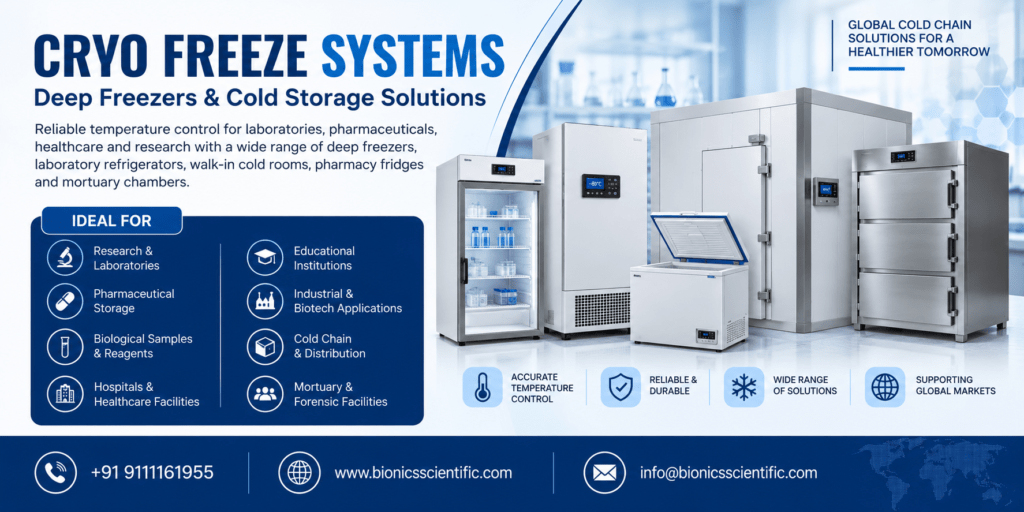
Cryo freeze” is used two ways in this space. Strictly, it refers to cryogenic-range freezing—storage at or near -80°C and below, using ULT freezers or liquid nitrogen/vapor-phase systems—for samples like cell lines, plasma, and biological repositories. More broadly, buyers use “cryo freeze” as a search term for any deep-cold or sub-zero storage need, including deep freezers, walk-in cold rooms, laboratory refrigerators, pharmacy fridges, and mortuary chambers.
This guide covers that broader equipment category, since that’s what most buyers searching the term are actually comparing—but the distinction matters if your requirement is specifically cryogenic/ULT storage rather than general deep-cold storage.
What Buyers Are Actually Trying to Solve
Most buyers researching “cryo freeze” aren’t shopping for one machine—they’re trying to match a storage problem to the right equipment class. A hospital blood bank, a vaccine distributor, a research lab, and a mortuary each need controlled cold storage, but at different temperatures, volumes, and compliance levels. The questions buyers actually ask are rarely about the marketing term; they’re about set-point accuracy, recovery time after a power cut, and whether the manufacturer can prove its certifications. That’s the lens this guide uses.
Certification Buyers Should Check First
Before comparing specs, buyers typically want to know who’s behind the equipment. Bionics Scientific is a manufacturing unit of Kartal Projects Pvt Ltd, Delhi, with 35 years in the sector. Kartal Projects holds certification listed as ISO 9001:2015 (Cert. No. 184876), CE under MDD 93/42/EEC (Cert. No. 184877), GMP (Cert. No. 184878), and NSF/ANSI 61 (Cert. No. 183884), issued by Euroglobe Registrars, a UK certification body established in 2007 (13-14 Old Square, London WC2A 3UT).
Certificate numbers, dates, and scope should be confirmed against the current, valid certificate copies before this is published, since compliance certificates are subject to renewal and scope changes. The GMP annexure lists laboratory refrigerators, deep freezers, and mortuary chambers within its scope.
Deep Freezers and Ultra-Low-Temperature (ULT) Storage
Cold-storage equipment is easiest to compare when the temperature bands don’t overlap. A clean breakdown:
- Standard deep freezer: -20°C to -40°C—general reagent and sample storage
- Ultra-low-temperature (ULT) freezer: -40°C to -86°C—vaccine banks, plasma, and biological repositories requiring cryogenic-range preservation
Deep freezer sizes range from 100-litre bench units to 500-litre-plus upright cabinets, scaling to multi-door or walk-in configurations for bulk inventory. Buyers evaluating either category should check:
- Temperature uniformity across shelves, not just at the sensor
- Recovery time after door openings
- Backup power and alarm systems—a ULT excursion can destroy an entire vaccine batch
- Insulation thickness, which affects both stability and running cost
Walk-In Cold Rooms and Walk-In Chillers
When volume exceeds what a cabinet freezer can hold, walk-in cold rooms and chillers are built as modular panel systems. There’s no single universal temperature that defines a “walk-in “chiller”—the set-point is commissioned around the product being stored: 2°C–8°C for pharmaceuticals, 15°C–25°C for climate-controlled ambient goods, or sub-zero for frozen inventory and biologics.
What buyers should confirm before ordering: the exact set-point required for their product, plus panel thickness, refrigeration load calculation, and door-seal design—these determine whether the room holds that set-point under real door traffic, not just on a spec sheet.
Laboratory Refrigerators
Laboratory refrigerators use forced-air circulation instead of static cooling, with continuous temperature logging and, where required, explosion-safe interiors. A laboratory refrigerator diagram typically shows a sealed cabinet, a top- or rear-mounted compressor, a forced-air evaporator coil circulating through perforated shelving, and a digital controller with a high/low alarm relay. That’s what separates a lab-grade unit from a repurposed household fridge: even cycling and no cold spots, not just a low average reading.
Bionics Scientific’s laboratory refrigerators are manufactured under the same NSF/ANSI 61-certified quality system (Cert. No. 183884) that covers the company’s laboratory and scientific equipment scope—note that NSF/ANSI 61 itself is a standard for materials and components in contact with drinking water, so buyers with water-contact requirements (e.g., water distillers, RO systems) should confirm the certificate’s exact applicability to their specific product before relying on it as a product-level claim.
Pharmacy Fridges
Pharmacy fridges hold the 2°C–8°C band required for vaccines, insulin, and temperature-sensitive medication. Buyers in this category usually prioritize data logging as standard, door type based on stock visibility, and audible/visual alarms for any deviation—increasingly a requirement in pharmacy cold-chain audits, not an optional extra.
Mortuary Chambers and Preservation Units
Mortuary storage needs depend on duration. Short-term holding runs 2°C to 4°C; extended preservation chambers—sometimes called a “dead fridge” informally—sustain -15°C to -20°C. Chambers are supplied single-body, multi-body, or walk-in, with corrosion-resistant interiors and independent refrigeration circuits per chamber, so one compressor failure doesn’t take down the whole unit. Mortuary chambers are named in the GMP certificate annexure (Cert. No. 184878).
Specification Reference Table
| Equipment Type | Typical Temperature Range | Common Configuration | Primary Application |
| Pharmacy Fridge | 2°C to 8°C | Single/double door | Vaccines, insulin, medicines |
| Laboratory Refrigerator | 2°C to 8°C | Forced-air, upright | Reagents, samples, media |
| Standard Deep Freezer | -20°C to -40°C | Upright/chest, multi-door | Reagent and sample storage |
| ULT Freezer | -40°C to -86°C | Upright, multi-door | Vaccine banks, plasma, repositories |
| Walk-In Chiller | Setpoint per application (typically 2°C–25°C) | Modular panel room | Bulk pharma, ambient goods |
| Walk-In Cold Room | Set point per application (chilled to sub-zero) | Pre-fabricated panels | Bulk cold storage, distribution |
| Mortuary Chamber (short-term) | 2°C to 4°C | Single/multi-body | Hospital mortuary |
| Mortuary Chamber (preservation) | -15°C to -20°C | Single/multi-body | Extended preservation |
Temperature Chart at a Glance
| Temperature Band | Equipment / Application |
| 2°C to 8°C | Pharmacy Fridge/Laboratory Refrigerator |
| 2°C to 4°C | Mortuary Short-Term Storage |
| -15°C to -20°C | Mortuary Preservation |
| -20°C to -40°C | Standard Deep Freezer |
| -40°C to -86°C | ULT Freezer (cryogenic-range storage) |
| Setpoint per application | Walk-In Chiller / Walk-In Cold Room |
What Buyers Should Verify Before Ordering
- Manufacturer certification—ask for certificate numbers and confirm current validity directly with the issuing body, not just from marketing material
- Load-tested capacity, not nameplate capacity
- Compressor redundancy for critical inventory (vaccine banks, plasma, mortuary preservation)
- After-sales service network—cold-chain failure is time-sensitive, not a routine repair
Cryo Freeze Equipment: Serving Global Cold-Chain Markets
Bionics Scientific supplies and supports deployments across the United States (USA), United Kingdom (UK), United Arab Emirates (UAE), Saudi Arabia, South Africa, Canada, Australia, Singapore, Malaysia, the Philippines, Indonesia, Kenya, Nigeria, Bangladesh, Nepal, Qatar, Oman, Kuwait, Bahrain, Vietnam, Thailand, Tanzania, Ghana, Sri Lanka, and New Zealand, alongside pan-India distribution.
Frequently Asked Questions
What does “cryo freeze” actually mean?
Strictly, cryogenic-range freezing at or below roughly -80°C. In everyday buyer searches, it’s also used broadly to mean any deep-cold storage equipment—deep freezers, cold rooms, lab refrigerators, and mortuary chambers.
What temperature should a pharmacy fridge maintain?
2°C to 8°C continuously, with alarms on any deviation.
What’s the difference between a walk-in chiller and a walk-in cold room?
Both are modular panel rooms; “chiller” usually refers to above-freezing set-points, while “cold room” can be configured chilled or sub-zero—the exact set-point is application-specific, not a fixed number.
What deep freezer sizes are available for lab use?
From bench-top 100-litre models to upright 500-litre-plus cabinets, up to multi-door and walk-in configurations for bulk storage.
What’s the difference between a standard deep freezer and a ULT freezer?
Standard deep freezers run -20°C to -40°C for general reagent and sample storage; ULT freezers run -40°C to -86°C for vaccine banks, plasma, and biological repositories needing cryogenic-range preservation.
What temperature is used for mortuary storage?
2°C to 4°C short-term; -15°C to -20°C for extended preservation units.
Is a “dead fridge” the same as a mortuary chamber?
It’s an informal term some buyers use—the correct technical term is “mortuary chamber” or “body preservation unit.”
What certifications should a cold storage manufacturer hold?
ISO 9001:2015 for quality management, CE for regulatory conformity, GMP for manufacturing practice, and, for water-contact components specifically, NSF/ANSI 61.
Does NSF/ANSI 61 certify laboratory refrigerators?
Not directly—NSF/ANSI 61 is a standard for materials and components in contact with drinking water. Buyers should confirm exactly what a manufacturer’s NSF/ANSI 61 certificate covers rather than assuming it applies to all lab equipment.
Does Bionics Scientific export cryo-freeze equipment internationally?
Yes, to markets across the Middle East, Africa, Southeast Asia, and beyond, alongside pan-India supply.
Get the Right Cryo-Freeze Solution for Your Facility
The right choice comes down to your required temperature band, volume, and compliance obligations—not the search term used to find it. Contact Bionics Scientific’s engineering team to specify equipment matched to your exact storage requirements, backed by ISO 9001:2015, CE, and GMP certified manufacturing.