Here’s something every quality engineer learns the hard way—products rarely fail on the test bench. They fail six months later, in a warehouse in Kochi during monsoon or in a truck cabin baking in a Rajasthan summer. By then, it’s too late to fix the design. That’s the whole reason a humidity chamber exists, and honestly, it’s one piece of lab equipment that earns its cost back the very first time it catches a problem before shipping.
We’ve been building environmental test equipment at Bionics Scientific for years now, working with labs and manufacturers across the country. So this isn’t a generic explainer pulled together for SEO purposes—it’s what we’d actually tell a customer walking into our facility asking, “Which chamber do I need?”
So, What Exactly Is a humidity test chamber?
Strip away the technical language, and a humidity test chamber is simply a sealed enclosure that lets you control moisture and temperature on demand. You set the conditions you want to test — say, 85% relative humidity at 40°C for 96 hours — and the chamber holds that environment steadily, so you can watch how your product responds.
Why does this matter?
Because you don’t have four months to wait and see if your packaging seal fails during actual monsoon season. A humidity test chamber lets you compress that same stress into a few days of lab time, and the data you get back is just as valid — arguably more useful, since it’s repeatable and documented.
This scenario is precisely why the equipment has become standard across electronics manufacturing, automotive components, aerospace parts, pharma packaging, and food storage testing. A recall costs lakhs. A test cycle costs a fraction of that.
Why This Matters More in India Specifically
Anyone who’s shipped a product across states knows the problem — what survives Delhi’s bone-dry winter might quietly corrode in Chennai’s coastal humidity three months later. If you’re manufacturing for pan-India distribution or exporting overseas, that variability isn’t a minor detail. It’s a real financial risk sitting inside your supply chain.
A dependable humidity test chamber gives you a way to actually see the risk coming:
- You catch material degradation, corrosion, or delamination before it reaches a customer
- Pharma and food packaging integrity gets validated properly, not guessed at
- You can demonstrate compliance against ISO, ASTM, IS, or IEC standards when buyers ask
- Warranty claims drop because failure modes get caught early
- Export buyers trust your QC process more when it’s backed by real environmental data
None of this is optional anymore, really. It’s become part of doing business responsibly.
Not All humidity test chambers Are Built the Same
This is where a lot of first-time buyers get it wrong—they assume “humidity test chamber” means one standard product. It doesn’t. The right type depends heavily on what you’re actually testing.
Standard humidity test chamber. Good for straightforward, humidity-only testing. Packaging, textiles, general material checks — nothing that needs temperature cycling layered in.
Temperature-humidity test chamber. This one runs temperature and humidity control together, in the same unit, at the same time. If you’re in electronics or automotive manufacturing, this model is probably what you actually need, since components rarely fail from moisture alone — it’s usually the combination of heat and humidity that causes the real damage.
Temperature and humidity test chamber with cyclic programming. Some setups go a step further and let you simulate actual weather transitions—day into night, one season into the next. Aerospace and defense testing tends to demand this level of realism, since a component might need to survive years of exactly this kind of fluctuation.
Walk-in humidity test chamber When you’re testing in bulk, or your product is simply too large for a benchtop unit, walk-in chambers let you run multiple items through the same test cycle at once. Saves time and, honestly, saves a fair amount of money over the long run too.
What Actually Matters When You’re Comparing Chambers
Here’s the honest truth—when you’re vetting a humidity chamber manufacturer, the price sheet tells you almost nothing about quality. These are the things worth actually digging into:
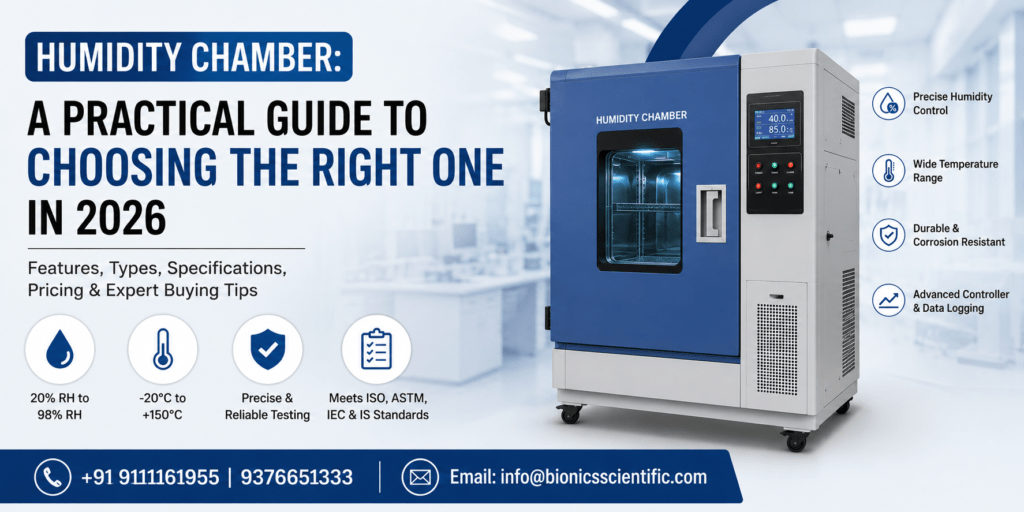
Range. Can it hit a wide temperature and humidity spread—ideally something like -20°C to +150°C and 20% RH up to 98% RH? A narrow range limits which standards you can test against later.
Uniformity, not just accuracy. A chamber can claim great accuracy at the sensor and still have hot spots or dead zones inside. Look for consistency of around ±0.5°C and ±2-3% RH across the entire chamber, not just at one measuring point.
What it’s built from. Stainless steel interiors hold up. Cheaper materials corrode faster under constant moisture exposure, which defeats the purpose of the machine within a couple of years.
The controller. A modern PID or microprocessor-based system with programmable cycles and data logging isn’t a luxury feature anymore — it’s what makes your test results audit-ready and defensible when a customer or regulator asks for records.
Standards compliance. Check that it actually meets IS, ISO 12207, ASTM D4332, and IEC 60068-2 where relevant to your industry—don’t just take a vague “yes, it’s compliant” at face value.
What happens after you buy it? Calibration support, spare parts availability, and how quickly someone shows up when something breaks — these factors end up mattering just as much as the machine itself, especially in labs running chambers daily.
Technical Specifications
| Parameter | Specification |
| Temperature Range | -20°C to +150°C |
| Humidity Range | 20% RH to 98% RH |
| Temperature Accuracy | ±0.5°C |
| Humidity Accuracy | ±2% RH |
| Chamber Capacity | 100L to 1000L+ |
| Controller | PID Microprocessor with Digital Display |
| Interior Material | SS 304 Stainless Steel |
| Standards | IEC 60068, ASTM, ISO, IS |
What Should You Expect to Pay?
Humidity chamber prices in India can vary quite a bit based on size, the temperature-humidity range you need, the build material, and how much automation is packed into the controller. A small benchtop unit will obviously cost far less than a walk-in chamber with cyclic programming and heavy-duty components — that’s just the nature of precision engineering.
But here’s the thing experienced buyers already know: chasing the lowest number on the quote usually backfires. A chamber that’s cheap upfront but has poor uniformity or breaks down every few months ends up costing more—through retesting, downtime, and, in the worst case, a compliance failure that reaches your customer.
At Bionics Scientific, we quote based on your actual testing requirements, not a generic price list. No hidden costs, no cutting corners on the build.
Why Manufacturers Choose to Work With Bionics Scientific
At Bionics Scientific, our focus is on delivering precision-engineered environmental testing solutions tailored to customer requirements. As a humidity chamber manufacturer working with clients across Pan-India, our focus stays on precision and practical customization—chambers built for the specific industry using them, whether that’s a pharma company, an electronics OEM, an automotive supplier, or a university research lab.
What that looks like in practice:
- Stainless-steel construction that actually holds up under years of humidity exposure
- Control systems built for accuracy, not just a nice display screen
- Chamber sizes customized around your actual products, not forced into a standard mold
- Installation and after-sales support that covers the whole country, not just metro cities
- Transparent humidity chamber price quotes with nothing buried in fine print
- Full compliance with the international standards your industry actually requires
Whether you need one humidity test chamber for an R&D bench or a complete temperature humidity chamber setup for production-line QC, our team works with you from the first consultation through to final installation.
Questions We Get Asked All the Time
What is a humidity chamber actually used for?
Mainly to see how a product holds up under controlled moisture and temperature exposure—it tells you a lot about durability before that product ever reaches a customer.
Is a humidity chamber the same thing as a temperature-humidity chamber?
Not quite. A standard humidity chamber only controls moisture. A temperature-humidity chamber runs both temperature and humidity together, which gives you a more realistic picture for most industrial applications.
Which industries rely on humidity test chambers most?
Electronics, pharma, automotive, aerospace, textiles, packaging, and food — basically any industry where moisture exposure can silently ruin a product over time.
Why does humidity chamber price vary so much between suppliers?
The main factors are chamber size, the temperature-humidity range it supports, build quality, and how advanced the controller is. Two chambers that look similar on paper can differ a lot in actual performance.
What’s a typical humidity range these chambers can hit?
Most industrial units run somewhere between 20% RH and 98% RH, with temperature ranges roughly from -20°C to +150°C—though the range varies by model.
Can Bionics Scientific build a chamber to our specific product dimensions? Yes—we regularly customize chamber size and configuration around the actual products a client is testing, rather than forcing a standard size to fit.
How frequently do humidity chambers have to be calibrated?
Typically once every 6-12 months, but in labs carrying out extensive testing, it is often done more frequently in order to maintain ISO/ASTM requirements.
Are there humidity chambers that can simulate seasonal variations in weather patterns and daily variations?
Yes, if you purchase a temperature and humidity chamber that has an option of cyclic programming.
Is your service and installation provided beyond metro areas?
Yes, we provide installation and services all across Pan-India.
How should one select a reliable manufacturer for humidity chambers?
Go by build quality, performance, and most importantly, the responsiveness of the service department once you have purchased the product.
Let’s Talk About Your Testing Requirements
At the end of the day, you can’t leave product reliability to chance—it directly ties to your brand’s reputation in the market. If you’re ready to bring a properly engineered humidity chamber into your lab or production line, Bionics Scientific would be glad to walk you through the options.
Reach out to Bionics Scientific for a customized quote, a technical consultation, or a live product demo — and start building products that actually hold up, whatever the climate throws at them.