
Search for “incubator diagram” online and you’ll find plenty of pictures, but not many that actually explain what you’re looking at. That’s usually the missing piece. A diagram is only useful once you know why the heating coil sits where it does, why there’s a fan tucked into the corner, or why the door has two layers instead of one. Once that clicks, the whole machine stops being a mystery box and starts making sense as a system.
This piece goes through that system in some detail—the working principle, the build, every labeled part, real-world uses in labs and industry, and what’s worth checking before you actually buy one.
What Is a Laboratory Incubator, Anyway?
Strip away the technical language, and an incubator is just an insulated box that holds a steady temperature. But “just” is doing a lot of work in that sentence—holding a temperature within half a degree, hour after hour, day after day, isn’t trivial. Inside that box, conditions are tuned for growing bacteria, fungi, cell cultures, or other biological samples, and better units also manage humidity and CO₂.
Look at a microbiology incubator diagram and you’ll see the same three elements every time: something that generates heat, something that measures it, and something that decides what to do with that information. Everything else in the design more or less supports that trio.
The Working Principle — and How It Shows Up in the Diagram
Nearly every laboratory incubator diagram you’ll come across is built on the same idea: controlled heating, backed by good insulation. In practice, the system operates as follows.
Heating rods on the inner walls of the box provide thermal energy to the inside atmosphere. The temperature of the box interior is constantly monitored by a sensor that feeds information to the controller. Once the temperature falls below the required level, the controller starts the heaters.
In the case of forced-air chambers, there is a fan installed that ensures an even distribution of warmth in the chamber.
What’s Inside: How These Units Are Actually Built
Once you understand the build, an incubator diagram with labels stops looking like a puzzle. Most bacteriological and microbiology incubators share a fairly standard structure, with some variation between manufacturers.
The outer body of the unit is typically mild steel with a powder coat finish, though some labs prefer stainless steel for corrosion resistance. The inner chamber is generally stainless steel (SS-304), as it is non-reactive and withstands sterilization. An insulation layer of glass wool or polyurethane foam maintains temperature, while the door features an inner glass panel for visibility without disrupting the internal climate. A control panel is located at the front, and inside, adjustable stainless steel perforated shelves facilitate air circulation around samples.
Incubator Diagram with Label: Component by Component
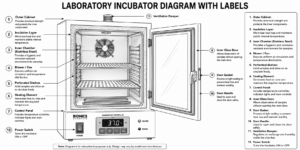
A properly labeled incubator picture doesn’t just point at shapes—it identifies parts that each do something specific.
Component and Function Table
| Component | Function |
| Outer Cabinet | The structural shell houses the insulation |
| Inner Chamber | Holds samples/cultures; stainless steel for hygiene |
| Insulation Layer | Cuts heat loss, stabilizes internal temperature |
| Heating Element | Brings chamber up to the set temperature |
| Thermostat/Sensor | Tracks internal temperature in real time |
| Digital Temperature Controller | Reads temperature and automates regulation |
| Blower/Fan | Moves air around to avoid hot or cold pockets |
| Perforated Shelves | Hold plates/flasks while letting air pass through |
| Inner Glass Door | Lets you check samples without opening the main door |
| Ventilation Damper | Manages fresh air exchange and humidity |
| Indicator Lights | Quick visual check on power/heating status |
| Power Switch | Turns the electrical supply on or off |
This feature is really what separates a functional bacteriological incubator diagram from a decorative one — every label ties back to something the machine is doing.
Typical Technical Specifications
| Parameter | Typical Specification |
| Temperature Range | Ambient: 5°C to 60°C / 70°C |
| Temperature Accuracy | ±0.5°C to ±1°C |
| Control Type | Digital PID/Microprocessor Controller |
| Chamber Material | Stainless Steel (SS-304) |
| Outer Body Material | Mild Steel (Powder Coated) / Stainless Steel |
| Insulation | Glass Wool / PUF |
| Capacity | 20 Litres to 1000+ Litres |
| Power Supply | 220–240V AC, 50 Hz |
| Shelves | 2 to 4 Adjustable Perforated Shelves |
| Additional Features | CO₂ control, humidity control, RS-232/USB data logging (optional) |
Treat these as ballpark figures—actual specs shift from model to model, so it’s worth double-checking against the datasheet before ordering.
Where These Get Used, in Practice
Walk into most microbiology or diagnostic labs, and you’ll find incubators running constantly—culturing bacteria and fungi, handling BOD (Biochemical Oxygen Demand) testing for environmental samples, or supporting cell and tissue culture work in biotech research. Pharmaceutical labs rely on them for sterility testing and shelf-life studies, and they’re a fixture in academic microbiology teaching facilities too.
Industry uses them just as heavily, if less visibly. Food and beverage manufacturers run quality control tests through incubators; pharmaceutical manufacturers use them for batch testing; water treatment facilities use them for environmental monitoring; and biotech manufacturers incubate vaccine or biologic samples as part of production.
What You Actually Gain From a Well-Built Unit
Consistency, mostly. A well-designed incubator removes a lot of the guesswork that would otherwise creep into results from one run to the next. The sealed, enclosed design keeps contamination risk down considerably, and automated regulation means you’re not standing over a thermometer adjusting a dial by hand. For labs working under GLP (Good Laboratory Practice) standards, that reliability isn’t a nice-to-have—it’s part of what compliance actually requires. And a genuinely well-insulated unit tends to cost noticeably less to run over time, simply because it isn’t fighting constant heat loss.
Keeping It Accurate: A Few Maintenance Habits
Calibrate the controller against a certified reference thermometer periodically — don’t rely solely on the display. Clean the inner chamber on a regular schedule with a mild disinfectant; it’s an easy spot for contamination to build up quietly. Check the door gaskets now and then, since worn seals let heat escape and force the heater to work harder than it should. It’s worth paying attention to the fan or blower too—uneven airflow tends to show up in your culture’s growth patterns before you’d ever notice it mechanically. Keep the ventilation dampers clear of dust, and try not to overload the shelves; packed shelves block airflow and create exactly the temperature unevenness you’re trying to avoid in the first place.
If You’re Buying One: What Actually Matters
Choose an incubator based on your application, required chamber capacity, and available space. Look for a stainless steel chamber, a digital microprocessor controller, ISO certification, and reliable after-sales support, including calibration, spare parts, installation, and service.
Frequently Asked Questions
What is the purpose of an incubator diagram?
This type of diagram illustrates the construction of the incubator and the principle of its work, which allows one to comprehend the process of temperature regulation and air circulation inside the chamber.
What are the major parts of a labeled incubator diagram?
The external cabinet, the internal chamber, the insulation, the heating unit, the thermostat, the digital controller, the fan/blower, the racks, and the internal glass door.
How does a bacteriological incubator differ from a laboratory incubator?
The bacteriological incubator is intended for the development of microorganisms within a certain narrow temperature range, while the laboratory incubator is designed for more general purposes and may include CO₂ and humidity control, as well.
What are the typical temperatures for laboratory incubators?
The typical temperature range is from ambient +5°C to 60-70°C.
Why is stainless steel used for the inner chamber?
Because stainless steel does not corrode, does not react with sample material, and can be sterilized multiple times, all features that make for a contamination-free chamber environment.
What is the purpose of the blower or fan in an incubator?
The function of the blower in the incubator is to maintain circulation of air in the chamber in order to avoid hot and cold spots that can affect culture development.
Do incubators control the level of humidity and CO₂?
Yes, higher-end models of incubators, particularly CO₂ incubators for cell cultures, have an integral humidity and CO₂ regulator.
How often should laboratory incubators be calibrated?
Once every 6 to 12 months in general, although it may vary according to the quality protocol set out by your lab.
What kind of industries make use of laboratory incubators?
Most common uses are pharmaceutical, biotechnological, food and beverage analysis, environmental monitoring, academic/research organizations, etc.
Where can I find a labeled diagram of a laboratory incubator?
Manufacturers such as Bionics Scientific will usually have the diagram attached to the product description on their web pages, which is very helpful prior to purchasing an incubator.
Final Thoughts
Once you understand the diagram—the working principle, the labeled parts, and how they connect—an incubator stops being a black box and becomes something you can actually troubleshoot, maintain, and buy with confidence. A bacteriological incubator built for microbial work and a precision unit built for pharmaceutical testing might look nearly identical from the outside, but knowing what’s happening inside each one is what lets you use either one correctly and keep it accurate for years.
Talk to Bionics Scientific
Bionics Scientific Technologies (P) Ltd. designs and supplies precision laboratory incubators—complete with detailed technical diagrams and documentation—to laboratories, hospitals, pharmaceutical companies, and research institutions across Pan India. Our team can help you match the right specifications to your application, provide technical support after installation, and put together a quotation built around your actual requirements.
Get in touch with Bionics Scientific for a full product catalog, expert consultation, and a competitive quotation—with delivery and support available anywhere in India.