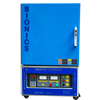
Rotary Tube Furnace Manufacturer in India
What Is a Rotary Tube Furnace?
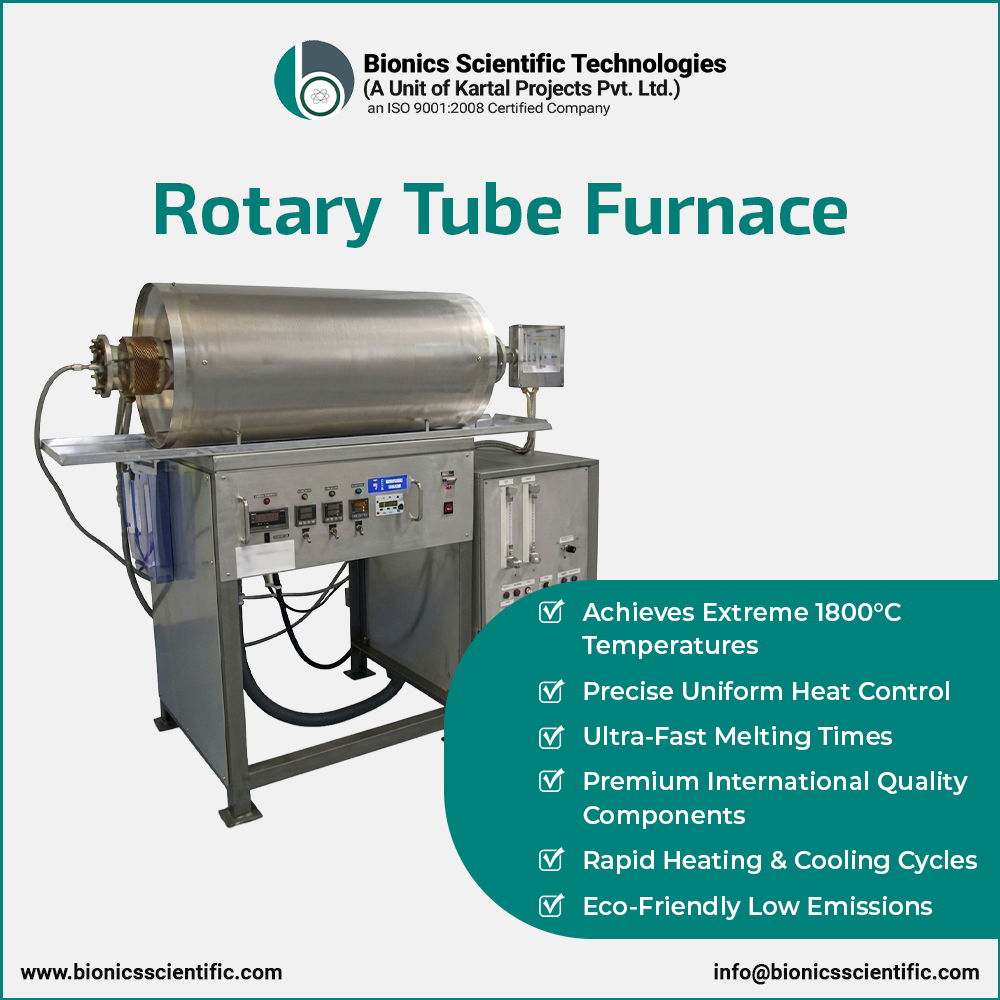
A rotary tube furnace is a tube furnace in which the process tube turns while it is heated, so powders and granular materials are tumbled and heated evenly instead of lying still in a boat. That movement helps every particle see the same temperature and the same gas atmosphere.
Rotary tube furnaces by Bionics Scientific are designed for controlled high-temperature heating of materials in laboratory and industrial applications. Available configurations include single, two and three heating zones, with models offering temperatures up to 1800°C based on the required furnace configuration. We have been manufacturing laboratory furnaces in India for 26 years.
Tube furnace configurations are available with single, two or three heating zones and can be designed for horizontal or vertical operation. Depending on the required application and model, configurations can also include rotary or vacuum tube furnace systems.
The tube-based design allows compatible end fittings and adapters to be selected according to the required process setup, tube configuration and application.
Rotary Tube Furnace at a Glance
- Temperature: 1100°C to 1800°C (models BST-TF1100 to BST-TF1800)
- Heating zones: one, two or three
- Orientation: horizontal or vertical
- Heating elements: molybdenum disilicide or lanthanum chromite
- Control: programmable, microprocessor based, with 16 programmable segments
- Construction: double-walled steel
- Power supply: 220 V
- Optional: computer interface
How a Rotary Tube Furnace Works
- The material is loaded into a process tube that passes through the heated chamber.
- The tube rotates, and in many designs is slightly tilted, so the material keeps moving.
- Heating elements surrounding the tube raise the temperature, and a thermocouple reports it to the controller.
- The programmable controller follows the heating, hold and cooling cycle you set.
- If the process needs an inert or reactive gas, or a vacuum, it is supplied through the end fittings.
- After cooling, the treated material is removed from the tube.
Rotation speed, tube size and material, tilt and feed arrangement are set for each project, so confirm them in your quotation.
Main Parts of a Rotary Tube Furnace
| Part | What it does |
|---|---|
| Process tube | Holds your material and turns during heating |
| Heating elements | Molybdenum disilicide or lanthanum chromite, side-wall mounted and replaceable |
| Thermocouple | Measures temperature and feeds the reading back to the controller |
| Controller | Programmable and microprocessor based, with 16 programmable segments; integrated or separate |
| Rotation drive | Turns the tube. Speed is set for each project |
| End fittings and seals | Connect gas lines or vacuum and seal the turning tube |
| Furnace body | Double-walled steel construction, with cooling fans |
| Safety devices | High-limit over-temperature protection, circuit breaker, power module and transformer |
Rotary vs Static Tube Furnace
| Point | Rotary tube furnace | Static tube furnace |
|---|---|---|
| Sample movement | Material is tumbled as the tube turns | Sample stays still in a boat or crucible |
| Best suited to | Powders and granules that need even exposure to heat and gas | Boats, crucibles, wafers and fixed samples |
| Mechanics | Needs a rotation drive and a sealing arrangement at the tube ends | Simpler, with no moving tube |
Advantages and Limitations
A rotary furnace is a good choice when your material is a loose powder or granule. It is not the right tool for everything.
- Advantage: tumbling gives more even heating than leaving a powder in a boat.
- Advantage: every particle is exposed to the process gas, so reactions are more uniform.
- Advantage: two or three zones let you shape the temperature profile along the tube.
- Limitation: it only suits free-flowing loose material. Solid pieces, wafers and crucibles are better in a static furnace.
- Limitation: the rotation drive and end seals add moving parts that need regular checking.
- Limitation: batch size is limited by the tube size.
If you are weighing a rotary tube furnace against a larger rotary kiln, tell us your batch size and whether you need continuous feed. We will say whether a rotary tube furnace is the right fit.
Rotary Tube Furnace Features
| Available up to 1800°C temperature | Uniform temperature control |
| Controlled high-temperature heating | Heating elements selected according to temperature requirements |
| Programmable heating and cooling control | Single, two and three-zone configurations |
Tube furnaces heat materials inside a process tube surrounded by heating elements, with temperature monitored using a thermocouple. Programmable controls can be used to manage heating and cooling cycles according to the selected furnace configuration.
Construction
The furnace uses double-walled steel construction, with horizontal or vertical configurations selected according to the required process setup and furnace model.
Temperature
Models are available with temperature ratings from 1100°C up to 1800°C, as listed in the technical specifications. Custom configurations can be discussed according to the required operating temperature and application. Temperature is controlled through an independent digital temperature controller with 16 programmable segments, which may be ordered separately. These control systems are either integrated with the tube furnace or attached separately.
Heating Elements
Depending on the required temperature and furnace configuration, units can be supplied with molybdenum disilicide or lanthanum chromite heating elements. The heating elements are side-wall mounted and can be replaced when required.
Safety Features
Available safety provisions include high-limit over-temperature protection and circuit protection, as listed in the technical specifications for the furnace configuration.
Rotary Tube Furnace Technical Specifications
| Models | BST-TF1100 | BST-TF1200 | BST-TF1300 | BST-TF1500 | BST-TF1700 | BST-TF1800 |
|---|---|---|---|---|---|---|
| Temperature | 1100°C | 1200°C | 1300°C | 1500°C | 1700°C | 1800°C |
| Temperature Control | Programmable, Microprocessor based | |||||
| Control system | Integrated or separated control system | |||||
| Zone | One, Two zones, Three zones | |||||
| Construction | Double Walled steel construction | |||||
| Safety | High limit over temperature protection, circuit breaker, power module, transformer and cooling fans | |||||
| Computer Interface | Optional | |||||
| Power Supply | 220 Volts | |||||
Tube diameter, heated length, tube material, rotation speed and power rating depend on the project. Share your requirement and we will confirm them in the quotation.
Where Rotary Tube Furnaces Are Used
Rotary tube furnaces are used wherever a loose material has to be heated evenly. Common examples are:
- Calcination and thermal decomposition of powders
- Synthesis and heat treatment of catalyst and battery materials
- Sintering, drying and roasting of granular materials
- Processing of ceramic, glass and metal oxide powders
- Materials research and process development in laboratories
Whether a particular process suits a given furnace depends on its temperature, tube material and atmosphere, so describe your process when you enquire. If calcination is new to you, Britannica's entry on calcination is a good short primer.
Terms You Will See When Comparing Furnaces
- Calcination
- Heating a solid to a high temperature to drive off volatile substances or break it down thermally.
- Sintering
- Heating a powder below its melting point so the particles bond together.
- Heating zone
- A section of the furnace with its own heating element and temperature control. More zones give more control over the temperature along the tube.
- Process tube
- The tube that holds your material inside the furnace. In a rotary furnace it is the part that turns.
How to Choose a Rotary Tube Furnace
- Temperature: pick a model rated above your working temperature, with some headroom. Models range from 1100°C to 1800°C.
- Zones: a single zone is simpler. Two or three zones give more control over the temperature profile along the tube.
- Orientation: choose horizontal or vertical according to how material is fed and removed.
- Atmosphere: if you need inert gas, reactive gas or vacuum, say so early, as it affects the end fittings. Our atmosphere furnace and vacuum furnace pages cover related options.
- Tube material and size: these depend on temperature and chemistry, so confirm them with us.
- Controls: decide whether you want the controller integrated or separate, and whether you need the optional computer interface.
For a static heating chamber instead of a tube, see our muffle furnace, or browse all laboratory furnaces.
Process Tube Material and Temperature
The tube has to survive your temperature and your chemistry, so it is worth choosing deliberately. The figures below are rough upper limits commonly quoted for these materials, not Bionics Scientific specifications.
| Tube material | Typical upper temperature | Worth knowing |
|---|---|---|
| Quartz | About 1100–1200°C | Transparent, so you can see the material. Suits lower-temperature work. |
| Mullite | About 1500–1600°C | A common mid-to-high temperature ceramic tube. |
| High-purity alumina | About 1700–1800°C | Used for the highest temperatures. Ceramic tubes dislike sudden temperature changes. |
Actual limits depend on the grade, wall thickness, atmosphere and heating rate. We confirm the tube for your model in the quotation.
Running a Rotary Tube Furnace Well
- Heat and cool gradually. Ceramic tubes can crack if the temperature changes too fast.
- Do not overfill the tube. The material needs room to tumble, or you lose the benefit of rotating.
- Check the seals at the tube ends before each run, especially if you use inert gas or vacuum.
- If your material is sensitive to oxygen, purge the tube with inert gas before you start heating.
- Keep the thermocouple and its connections in good condition, since the controller depends on that reading.
- Inspect the heating elements, tube and rotation drive on a regular schedule, and keep a simple log of what you find.
Safety Around a Hot, Rotating Furnace
- The furnace body, tube ends and fittings stay hot after a run. Use heat-resistant gloves and let everything cool before you open it.
- Keep hands, clothing and cables away from the rotating tube.
- If you use reactive or flammable gases, follow your site's gas safety rules and vent exhaust gas safely.
- Follow the operating manual and your laboratory's own safety procedure.
Other Tube Furnace Configurations
- One, Two and Three Zones Wire-Wound Tube Furnaces
- One, Two and Three Zones Horizontal Split-Hinge Tube Furnaces
- One, Two and Three Zones Vertical Split-Hinge Tube Furnaces
- One, Two and Three Zones Large Bore Tube Furnaces
- One, Two and Three Zones High Temperature Tube Furnaces
- One, Two and Three Zones Horizontal Tube Furnaces
- Vertical Tube Furnaces Rotary Reactor Furnaces
- Thermocouple Calibration Furnace
Tube furnace models are available in standard and custom configurations based on the required temperature range, heating zones, orientation and application. Contact our team to discuss the appropriate furnace configuration for your laboratory or industrial process.
Rotary Tube Furnace Price in India
The price depends on the temperature rating, number of zones, tube size and material, orientation, controller type, atmosphere or vacuum provisions and any custom features. A 1100°C single-zone unit costs less than a three-zone unit at 1800°C. Send us your requirement and we will quote for that configuration.
Why Buy a Rotary Tube Furnace From Bionics Scientific?
We are a manufacturer, not a reseller, and we have been making laboratory furnaces in India for 26 years. That means you speak to the people who build the furnace. We confirm the model, tube, atmosphere provisions and controller with you in writing before you order, and we can discuss custom configurations when a standard model does not fit. You can read more about Bionics Scientific or contact us directly.
What to Send With Your Enquiry
| Detail | Why we ask |
|---|---|
| Maximum working temperature | Decides the model and the heating element |
| Number of zones | Sets how closely the temperature profile can be shaped |
| Horizontal or vertical | Affects how material is fed and removed |
| Material and form (powder, granules, quantity per batch) | Sizes the tube and checks rotation suits the material |
| Atmosphere or vacuum | Decides the end fittings and sealing arrangement |
| Power supply and delivery location | Confirms electrical needs and delivery |
Need help selecting a rotary tube furnace? Contact our team to discuss the required temperature range, heating zones, horizontal or vertical configuration and application.
Rotary Tube Furnace FAQs
What is a rotary tube furnace?
A rotary tube furnace is a tube furnace in which the process tube turns during heating, so powders and granular materials are tumbled and heated evenly.
How is it different from a static tube furnace?
In a static tube furnace the sample sits still in a boat or crucible. In a rotary furnace the material keeps moving, which suits powders that need even exposure to heat and gas.
What are the advantages and limitations of a rotary tube furnace?
It heats powders and granules evenly and exposes them uniformly to the gas atmosphere. It only suits free-flowing loose material, and the rotation drive and end seals add mechanical complexity compared with a static furnace.
What temperatures are available?
Models are rated at 1100, 1200, 1300, 1500, 1700 and 1800°C, from BST-TF1100 to BST-TF1800.
How many heating zones are available?
One, two or three heating zones.
Can the furnace be horizontal or vertical?
Both orientations can be designed, depending on the process setup and furnace model.
Which heating elements are used?
Molybdenum disilicide or lanthanum chromite elements, depending on the temperature and configuration. They are side-wall mounted and can be replaced when required.
What controls does the furnace have?
A programmable, microprocessor-based digital controller with 16 programmable segments. It can be integrated with the furnace or supplied separately. A computer interface is optional.
Which process tube material should I choose?
It depends on your maximum temperature and the chemistry of your material. Quartz suits lower temperatures, while mullite and high-purity alumina are used higher. We confirm the right tube for your model in the quotation.
What should I send to get a quotation?
Send the maximum temperature, number of zones, orientation, tube size and material, atmosphere or vacuum need, sample form and quantity, power supply and delivery location.
Related Laboratory Furnace Products