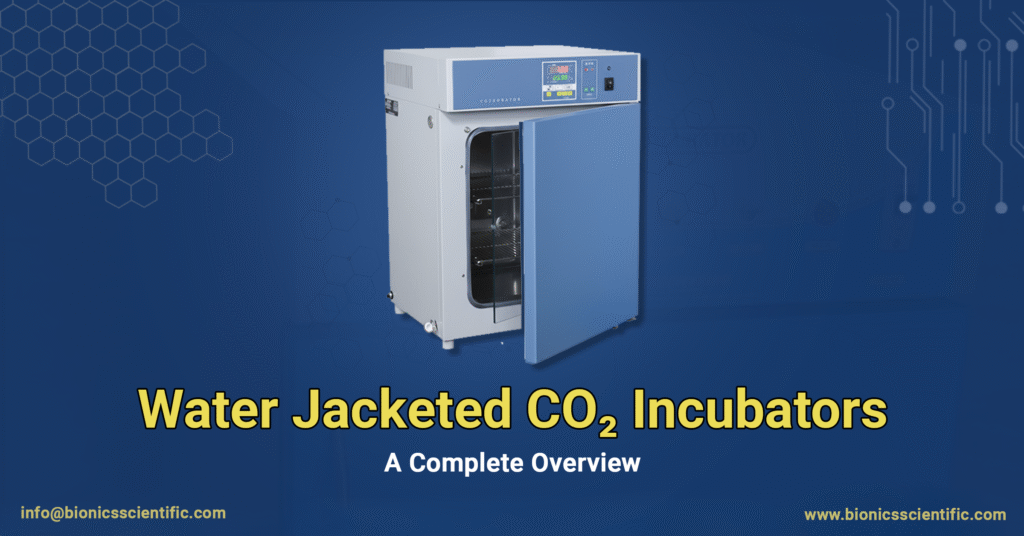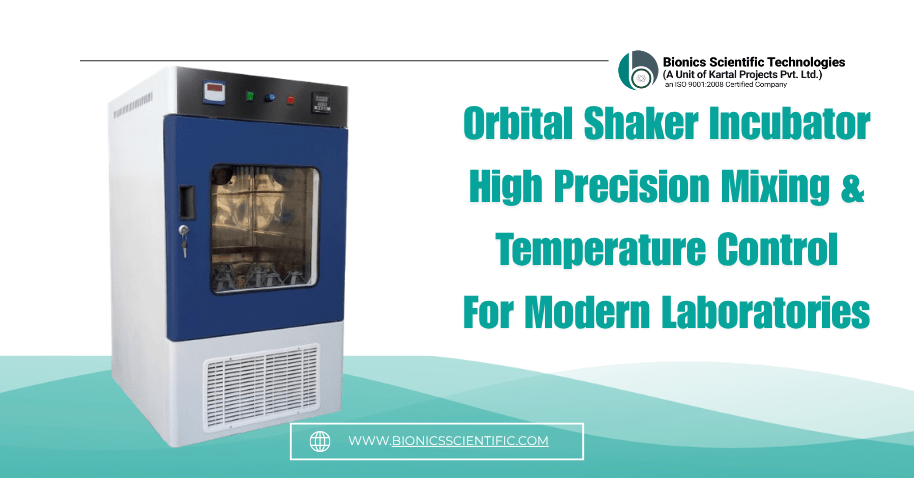

Incubators are cabinets that regulate temperature in generating an artificial environment for cultivation and growth of microbial cultures and cell lines in the laboratory. Incubators can either be humidified, CO₂ regulated, cooled, or agitated depending on the use intended.
This manual will assist you in comprehending how incubators work, different types of incubators, uses of incubators, and factors to consider while selecting an incubator.
Walk into almost any microbiology lab, pharma QC department, or research facility in India, and you’ll spot one in the corner—humming away, rarely getting much attention, and doing quietly essential work. That’s the lab incubator for you. It doesn’t make headlines. But ask any lab technician what happens if it fails on the wrong day, and you’ll understand exactly why it matters.
At Bionics Scientific, we’ve spent years building and supplying laboratory equipment to institutions all over the country, and if there’s one instrument that comes up in nearly every conversation with a researcher, it’s this one. So let’s actually talk about it—what it is, how it works, the different types you’ll come across, and why the “right” incubator isn’t always the obvious one.
Laboratory Incubator at a Glance
Use: Environmental control for biological materials
Common uses: Microbiology, pharmaceuticals, diagnostic laboratories, scientific research
Common types: Bacteriological, CO₂, refrigeration, shaking, vacuum
Temperature: Varies according to type and intended use
Advanced features: Control of humidity, CO₂, cooling and stirring
Choosing depends upon: Material, temperature, size and controls required
What Is a Laboratory Incubator?
Here’s the simplest way to put it: an incubator is a chamber that holds a stable, favorable environment so that microbial cultures, cell lines, or biological samples can grow the way they’re supposed to. Not too hot, not too cold, not too dry—just right and kept that way for however long the experiment demands.
People sometimes confuse it with an oven or a warming cabinet. It isn’t either. An oven doesn’t care what’s inside it. An incubator does. It holds temperature (and often humidity, sometimes CO₂) steady regardless of what’s happening in the room outside—whether that’s a Delhi summer or a Bengaluru monsoon. That steadiness is what really matters. Without it, your results aren’t really results; they’re guesswork.
So What Does an Incubator Actually Do?
The incubator function, boiled down, is this: create and hold a contamination-controlled environment where biological material can grow, multiply, or simply survive without stress.
And it’s not just microbiology. Enzyme reaction studies use incubators. Poultry researchers use them for egg hatching trials. Environmental labs rely on them for BOD (Biochemical Oxygen Demand) testing. Even some industrial QC lines keep one running. That range of use is precisely why we’d call the incubator instrument foundational—not a specialty item, but something close to non-negotiable in a working lab.
How Does It Work? The Incubator Working Principle Explained
There’s more engineering packed into this “simple box” than most people assume.
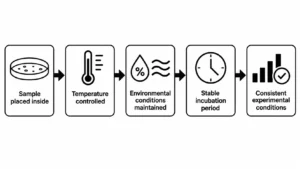
The basic principle behind the function of the incubator lies in an insulated enclosed area, where the heaters and, in more complex devices, even coolers, react constantly to the feedback received from a sensor inside the incubator. A step-by-step analysis of how incubators work is as follows:
- Heating system – electrical elements warm the air inside the chamber.
- Temperature sensor – a thermostat or digital probe tracks the internal temperature in real time.
- Control panel – you set the target incubator temperature, and the system adjusts the heat output on its own to hold it there.
- Insulated chamber – double-walled construction keeps heat from escaping and keeps outside temperature swings from sneaking in.
- Air circulation – fans (or, in simpler units, natural convection) keep the temperature even throughout, so there are no hot corners and no cold shelves.
Add humidity control and CO₂ regulation on top of that, and you’ve got a unit capable of handling far more delicate work, like cell culture.
Temperature and Humidity: The Two Things You Can’t Get Wrong
If there’s one section of this article worth bookmarking, it’s this one. Incubator temperature and humidity are where precision either pays off or costs you a failed batch.
The incubation temperature required varies depending on the particular microorganism being tested, the method used for testing and the procedures of the particular laboratory. Although 37°C is widely applied in bacteria cultures, it cannot be applied as the standard temperature.
Humidity matters just as much, particularly for tissue culture work or any sample that dries out easily. This is where a humidity test chamber earns its place—a standard incubator is built primarily around temperature control, but humidity-controlled variants layer both factors together to recreate the exact environmental conditions advanced research demands.
Types of Incubator: They’re Not All Interchangeable
This scenario is where a lot of first-time buyers go wrong — assuming one incubator is basically like another. It isn’t. Here’s a rundown of the types of incubator you’re likely to encounter:
- Bacteriological incubator – the workhorse. Standard temperature range, general-purpose microbial culturing. Most teaching labs and diagnostic setups run on these devices.
- CO₂ incubator – built for mammalian cell culture, where CO₂ concentration is as important as temperature and humidity.
- Cooled/refrigerated incubator – for samples that need to sit below room temperature, common in BOD testing and environmental work.
- Shaking incubator—incubation plus continuous agitation, useful for liquid cultures that need constant mixing.
- Vacuum incubator – designed for specialized, reduced-pressure applications.
Each one serves a genuinely different application of incubator technology. Picking the wrong type doesn’t just underperform — it can quietly ruin your results without you noticing until much later.
A Quick Side-by-Side: Incubator Types Compared
Occasionally a table just makes the comparison easier than paragraphs. Here’s how the main types stack up:
| Incubator Type | Temperature Range | Humidity/CO₂ Control | Best Suited For |
| Bacteriological Incubator | 25°C – 65°C | No | General microbial culturing, teaching labs, diagnostics |
| CO₂ Incubator | 25°C – 45°C | Yes (CO₂ + Humidity) | Mammalian cell culture, tissue engineering |
| Cooled/Refrigerated Incubator | 0°C – 60°C | No | BOD testing, environmental sample incubation |
| Shaking Incubator | 25°C – 60°C | No | Liquid cultures requiring agitation |
| Vacuum Incubator | 25°C – 65°C | Optional | Specialized low-pressure applications |
| Humidity Test Chamber (paired incubation) | 20°C – 60°C | Yes (humidity-focused) | Stability testing, pharmaceutical R&D |
Treat this as a starting point, not a final answer—your sample type, required precision, and daily workflow will ultimately decide which one fits. If you’re unsure, our team at Bionics Scientific is happy to talk it through with you.
Certifications & Quality Compliance
| Standard | Cert. No. | Scope | Valid Until |
| ISO 9001:2015 (QMS) | 184876 | Lab, scientific & cleanroom equipment mfg. | 30-03-2029 |
| CE (MDD 93/42/EEC) | 184877 | Products as per annexure | 30-03-2029 |
| GMP | 184878 | Includes fume hood and a biosafety cabinet. | 30-03-2029 |
| NSF/ANSI 61 | 183884 | Bio-safety cabinet, lab & scientific equipment | 08-03-2027 |
What Incubator Should You Use?
- Microbiological applications: Bacteriological incubator
- Mammalian tissue culture: CO2 incubator
- BOD and environmental tests: Refrigerated incubator
- Agitation liquid culture: Shaking incubator
- Low-pressure applications: Vacuum incubator
- Stability and humidity tests: Humidity control chamber
Where You’ll Actually Find Incubators at Work
The incubator uses in laboratory settings stretch across nearly every corner of the life sciences. A short list of where they show up daily:
- Incubation in microbiology—growing bacterial, fungal, or yeast cultures for identification, research, or diagnostics.
- Pharmaceutical testing – stability testing, sterility checks, and microbial limit testing on drug formulations.
- Food and beverage industry – screening products for microbial contamination before they hit shelves.
- Academic and research institutions – both teaching core microbiology concepts and supporting active research.
- Clinical diagnostic labs – culturing patient samples so that pathogens can be identified and treated correctly.
This breadth of incubator uses in microbiology and adjacent fields explains why demand for a dependable incubation chamber keeps climbing steadily across Indian labs, hospitals, and research centers—the applications only keep expanding.
Why the Purpose of an Incubator Goes Deeper Than “Keeping Things Warm”
It’s tempting to think of the purpose of incubator equipment as just heating. It’s really about removing variability—creating conditions that repeat, day after day, batch after batch, no matter what’s going on outside the lab door.
That matters more in India than in most places, honestly. A lab in Chennai deals with humidity levels a lab in Jodhpur never sees. A biological incubator that can hold its internal conditions steady regardless of the climate outside isn’t a nice-to-have here—it’s the baseline requirement.
That’s the thinking behind every incubator we build at Bionics Scientific. Labs don’t get to pause for “ideal conditions.” Equipment needs to perform on a humid July afternoon just as reliably as it does in December.
Why Labs Across India Choose Bionics Scientific
We’re not interested in just selling boxes that heat up. At Bionics Scientific, we build instruments that researchers, diagnostic labs, pharmaceutical companies, and academic institutions can actually rely on—day in, day out. Precise temperature control, solid insulation, interfaces that don’t require a manual every time you touch them, and support that actually responds when you need it.
Need a straightforward bacteriological incubator for a teaching lab? We’ve got that. Need a more advanced humidity test chamber for pharmaceutical stability studies? Also covered. Our range is built around Indian lab conditions and Indian budgets — without cutting corners on accuracy or build quality.
Reasons for Choosing Bionics Scientific
- Application-oriented design
Specialised products for use in microbiology, pharmacy, and diagnostic & research applications. - Control of Temperature
Designed specifically to provide temperature controlled incubation based on application needs. - Diverse models
Wide variety of incubators including general purpose, CO2, refrigerated and many others. - Technical Support
Support in the form of technical help for selecting, installing and maintaining the product.
Looking for an incubator that won’t let you down when it matters most?
Reach out to Bionics Scientific for expert advice and a quote built around your lab’s actual needs.
FAQs (Frequently Asked Questions)
How can an incubator be helpful in a laboratory?
An incubator is useful in the cultivation and maintenance of bacterial cultures or cell lines or biological samples under certain conditions, such as temperature and sometimes humidity and CO₂.
What is the suitable incubator temperature for bacterial culture?
In most bacterial experiments, temperature is maintained at 37°C. The usable temperatures lie between 25°C and 45°C depending on the bacteria.
What is the role of an incubator?
Incubators help create an environment which is controlled and specifically adapted for certain biological applications. These environments can have various parameters including temperature, humidity, carbon dioxide levels, cooling or shaking.
What are some commonly used incubators in laboratories?
Common types of incubators are bacteriological, CO₂, refrigerated, shaken, and vacuum incubators.
What makes a bacteriological incubator different from a CO₂ incubator?
A bacteriological incubator controls only the temperature. A CO₂ incubator controls the levels of carbon dioxide, which is required by mammalian cell culture.
Humidity is also controlled in an incubator, besides temperature control?
Yes, some of the incubators do have humidity control in addition to temperature control. This all depends upon the application and the kind of incubator being used.
What are the industries where incubator instruments are most used?
They are found in pharmaceuticals, clinical diagnostics, food and beverage testing, academic research, and biotechnology.
How to choose the right incubator for your lab?
First, your required temperature range, sample volume, and if you need humidity or CO₂ control—then the type of application helps to narrow down the options from there.
Why buy a lab incubator from Bionics Scientific?
Because our incubators are built for Indian laboratory conditions with reliability and support that you can count on when you need it.