
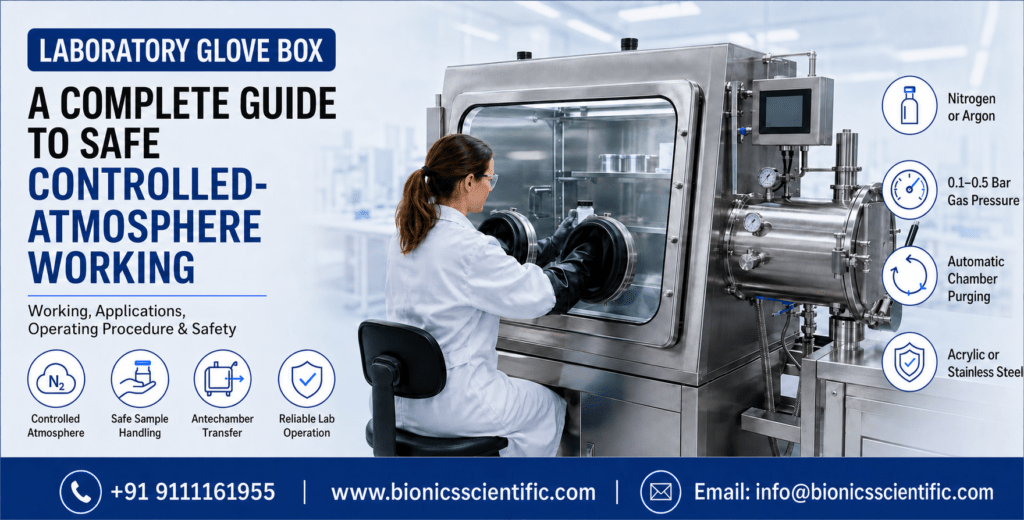
This laboratory glove box guide explains how a glove box works, its important applications, operating procedures, available configurations, and essential safety precautions.
Laboratory Glove Box Guide to Working and Applications
A laboratory glove box is an enclosed chamber fitted with sealed glove ports, through which an operator can handle materials inside a controlled atmosphere without contact with the surrounding air. The chamber is usually maintained under an inert gas, such as nitrogen or argon, suited to oxygen- or moisture-sensitive work. Depending on the application, the chamber can be built from acrylic or stainless steel, and most units include a separate antechamber for moving samples in and out.
How Does a Laboratory Glove Box Work?
A laboratory glove box works by maintaining a controlled atmosphere inside a sealed chamber. Nitrogen or argon is introduced through the gas inlet to reduce exposure to oxygen and moisture, while the controller manages purging and monitors the chamber conditions. Samples are transferred through the antechamber so the main chamber environment is disturbed as little as possible.
Important Applications of a Laboratory Glove Box
Our laboratory glove box guide covers applications in pharmaceutical, chemical, electronics and material-science laboratories.
- Research laboratories – air-sensitive compounds and reactive intermediates
- Pharmaceuticals – formulations that degrade on exposure to moisture
- Chemical laboratories – synthesis and handling of oxygen-sensitive reagents
- Electronics – assembly of components sensitive to humidity
- Materials Science – materials that are sensitive to oxygen, moisture or ambient air conditions
- Lithium-ion battery research – cell assembly and testing in an oxygen- and moisture-free environment
- Quality-control laboratories – inspection and testing under consistent atmospheric conditions
The right configuration depends on the application, chamber size, construction material, gas used, and required working environment.
Operating Procedure for a Laboratory Glove Box
The following steps provide a general operating sequence. Always follow the operating manual supplied with your glove box and your laboratory SOP for model-specific instructions.
- First connect the glove assembly before turning anything on.
- Wire the controller; it connects to the gas inlet, gas outlet, and sensor wiring.
- Connect the power source. The power board and controller connect to a 230V supply.
- Seal the chamber and connect gas. Make sure the doors to the main chamber and antechamber are locked tight.
- Connect nitrogen or argon to the gas inlet valve.
- Switch on the controller.
- Set the required parameters. The gas inlet/outlet functions then carry out automatic purging of the main chamber.
- Purge the antechamber manually with nitrogen or argon and the required vacuum cycle before loading or unloading a sample.
- Maintain gas inlet pressure between 0.1 and 0.5 bar throughout operation.
- Take off rings, watches, bracelets, and other sharp objects before putting on the gloves.
- Before operation, check the vacuum pump oil level. The oil level should be between the minimum and maximum marks.
Only trained personnel should carry this out, following the equipment manual and the lab’s SOP.
Laboratory Glove Box – Specification Overview
The table below lists only the parameters confirmed above—not a full spec sheet. Chamber dimensions, filtration efficiency, and other model-specific figures depend on the configuration and require confirmation from our team.
| Parameter | Detail |
| Power supply | 230V, connected to the power board and controller |
| Purge gas | Nitrogen or Argon |
| Gas inlet pressure | 0.1 – 0.5 bar (maintain within this range) |
| Main chamber purging | Automatic, through the controller-linked gas inlet/outlet |
| Antechamber purging | Manual, using nitrogen or argon with a vacuum cycle |
| Construction options | Acrylic (Transparent) or Stainless Steel |
| Optional configurations | HEPA filtration, microscope integration, lithium-ion battery setup |
| Vacuum pump check | Oil level between minimum and maximum marks before use |
| Glove-use precaution | No rings, watches, bracelets, or sharp jewellery |
Sample Loading and Unloading Through the Antechamber
Samples are typically transferred into and out of the main chamber through the antechamber. Before transfer, the antechamber is purged according to the equipment operating procedure to help minimize changes to the controlled atmosphere inside the main chamber.
Available Application-Based Configurations
Bionics Scientific offers its glove boxes in a number of configurations, chosen by application rather than bundled as standard on every unit:
- HEPA Filtration Glove Box—designed for applications where filtered air handling is required as part of the laboratory process.
- Glove Box with Microscope – integrates microscopic observation into the workspace
- Glove Box Lithium Ion Battery – set up for battery assembly and testing
- Stainless Steel Glove Box – a more robust, corrosion-resistant build
- Transparent Glove Box – acrylic construction with full workspace visibility
Acrylic tends to suit general laboratory work where visibility is a priority, while stainless steel is chosen where durability matters more. Not every model comes with every optional configuration.
Operating and Safety Precautions
Before starting a purge cycle, check that the chamber and antechamber doors are properly closed and that all required gas connections are secure. A glove box is not automatically a substitute for a biosafety cabinet, chemical fume hood, or explosion-proof enclosure unless it’s specifically designed and certified for that purpose. Always work from the supplied manual and your laboratory’s SOP.
Why Choose Bionics Scientific?
Bionics Scientific takes an application-first approach to configuration rather than one fixed build for every customer—matching gas requirements, chamber size, and construction preference to the right setup, whether acrylic, stainless steel, HEPA-filtered, microscope-fitted, or lithium-ion battery-ready.
Conclusion:
This laboratory glove box guide can help you identify a suitable configuration for your controlled-atmosphere workflow.
Frequently Asked Questions
What gas is used inside a laboratory glove box?
Nitrogen or argon is typically connected to the gas inlet valve, creating the inert atmosphere needed for oxygen- or moisture-sensitive materials.
What gas inlet pressure should be maintained?
For this configuration, the gas inlet pressure should be maintained between 0.1 and 0.5 bar during operation. Always follow the pressure range specified in the equipment manual for the selected glove box model.
Why does the antechamber need to be purged manually and not automatically?
The antechamber is purged manually using nitrogen or argon with a vacuum cycle prior to sample transfer.
Can a laboratory glove box be used for lithium-ion battery work?
A glove box lithium-ion battery configuration supports cell assembly and testing inside a controlled, oxygen- and moisture-free environment.
What does HEPA filtration add to a glove box?
A HEPA filtration glove box is configured for workflows where filtered air handling is part of the required process rather than a standard feature across all builds.
Can a microscope be integrated into a glove box?
The glove box with a microscope design allows direct observation through the microscope without the need to extract any samples from the chamber.
Should I choose an acrylic or stainless steel glove box?
The choice depends on your application. Acrylic glove boxes provide clear visibility of the working area, while stainless steel glove boxes are generally preferred where greater durability and a robust chamber construction are required.
Why must I remove my jewelry before wearing the gloves?
Your rings, watch, bracelet, and any other sharp jewelry may damage the glove material or its seal at the glove ports.
How often should vacuum pump oil be checked?
The oil level should be checked before each operation to confirm it sits between the minimum and maximum marks on the pump.
Is a laboratory glove box the same as a biosafety cabinet?
No. A glove box does not automatically replace a biosafety cabinet, chemical fume hood, or explosion-proof enclosure unless it has been specifically designed and certified for that purpose.
Get the Right Laboratory Glove Box for Your Application
Choosing the right laboratory glove box comes down to gas requirements, chamber size, construction material, and application. Bionics Scientific can talk you through configuration options—from HEPA filtration to microscope integration to stainless steel builds—and help you settle on a setup that fits your workflow. Contact Bionics Scientific today to discuss your requirements and get a customized quotation.