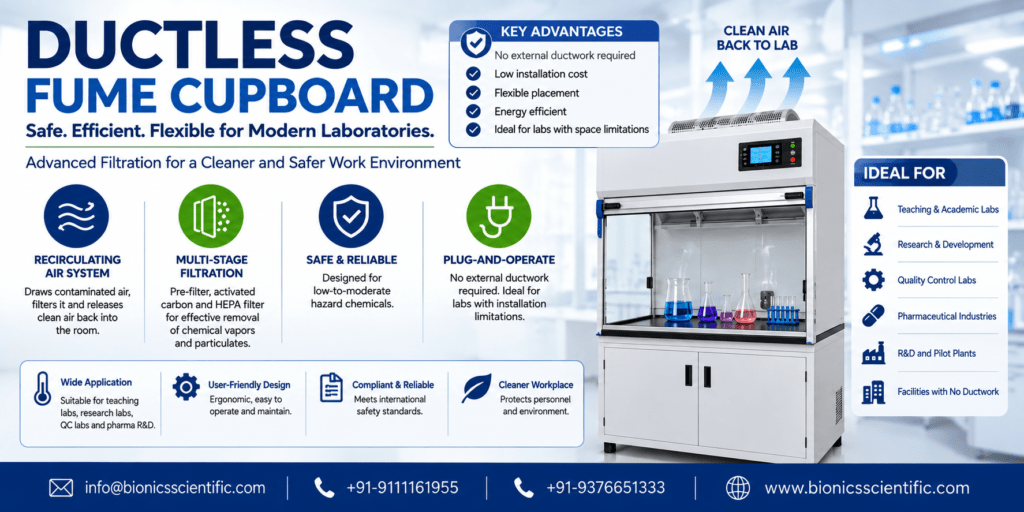
Quick Answer: A ductless fume cupboard is a laboratory containment enclosure that draws contaminated air through a multi-stage carbon/HEPA filter bank and recirculates cleaned air back into the room, instead of exhausting it outdoors through ductwork. It is used for handling low-to-moderate hazard chemical vapors, powders, and fumes where a permanent exhaust duct is impractical, expensive, or unavailable—common in teaching labs, QC labs, pharma R&D, and facilities retrofitting older buildings. Filter selection must always match the specific chemical class being used, since no single filter media captures every vapor type.
Bionics Scientific has been designing and manufacturing laboratory containment and safety equipment for 35 years, with autoclaves, fume hoods, and biosafety cabinets dispatched across India and to international markets, including the USA, UK, UAE, Saudi Arabia, Canada, Australia, and the Gulf and Southeast Asian regions. This guide explains how ductless fume cupboards work, where they fit against ducted alternatives, and what to check before you specify one.
What Is a Ductless Fume Cupboard?
A ductless fume cupboard—also called a ductless fume hood or recirculating fume hood—is an enclosed workstation with a sash opening at the front, an internal blower, and a stacked filtration chamber positioned between the work zone and the exhaust outlet on top or at the rear of the unit. Air is pulled in through the sash opening, passed through the filter media, and released back into the laboratory. Because there is no connection to an external duct or rooftop exhaust stack, installation does not require structural modification to the building—the unit is essentially plug-and-operate once placed on a bench or a dedicated stand.
This distinguishes it from a ducted (conventional) fume hood, which pulls air through the enclosure and exhausts it directly outside the building via ductwork connected to a building exhaust fan. Ducted hoods are generally specified where high-hazard, high-volume, or unknown-mixture chemical work takes place, since dilution and dispersal outdoors is more forgiving of filtration gaps. Ductless units are specified where the chemical inventory is well-defined, exposure limits are low-to-moderate, and installing ductwork is not feasible—for example, in a rented facility, an upper-floor lab, or a room without access to an external wall.
Working Principle
The core of a ductless fume cupboard is its filtration train, typically arranged as follows:
- Pre-filter stage—captures larger particulates and dust before they reach the main filter media, extending the life of the primary filter.
- Primary filter (activated carbon or specialty-impregnated carbon)—adsorbs specific classes of gaseous and vapor-phase chemicals. Filter chemistry must be matched to the compounds in use (for example, standard activated carbon is not effective against formaldehyde, and a different impregnated media is required).
- HEPA filter (where particulate or biological containment is also required)—captures fine particles down to 0.3 microns at rated efficiency, used in combination with carbon filtration for powder-handling applications.
- Blower/motor assembly—maintains the face velocity across the sash opening needed to draw contaminants away from the operator’s breathing zone and into the filter stack.
- Filter saturation monitoring—many units include a gas sensor or scheduled-replacement indicator, since carbon filters do not visibly show saturation the way a particulate filter does; once saturated, a carbon filter will pass contaminants through rather than trapping them.
Because the filtered air re-enters the room, filter selection and replacement scheduling are the two variables that determine whether a ductless unit provides real protection or a false sense of containment. This is the single most important specification decision when procuring one of these units, more so than cabinet dimensions or airflow numbers alone.
Ductless Fume Cupboard vs. Ducted Fume Hood
| Factor | Ductless Fume Cupboard | Ducted Fume Hood |
| Air handling | Recirculates filtered air into the room | Exhausts air outside the building |
| Installation | No external ductwork required | Requires duct run and exhaust fan |
| Best suited for | Known, low-to-moderate hazard chemicals in defined quantities | High-hazard, high-volume, or mixed/unknown chemical use |
| Ongoing cost driver | Scheduled filter replacement | Exhaust fan energy and duct maintenance |
| Relocation | Portable/repositionable | Fixed to duct routing |
| Filter dependency | High—protection depends entirely on correct filter media and replacement. | Low—dilution and outdoor dispersal reduce dependency on filtration alone. |
Chemical Storage Shelves: A Related but Separate Requirement
A ductless fume hood is used for active handling and manipulation of chemicals; it is not designed as a chemical storage location. Chemicals awaiting use or returned after a procedure should be kept on dedicated chemical storage shelves built for laboratory environments—typically corrosion-resistant coated steel or polypropylene construction, with containment lips to catch spills, segregated compartments for incompatible chemical classes (acids separated from bases, oxidizers separated from flammables), and clear labeling systems. Many labs specifying a ductless fume cupboard purchase compatible chemical storage shelving in the same procurement cycle, since both fall under the same chemical hygiene plan and the same inspection checklist.
Specification Table
| Parameter | Typical Range / Detail |
| Sash opening height | 250–500 mm (model-dependent) |
| Working chamber material | Epoxy-coated steel or PP (polypropylene) lining for corrosion resistance |
| Filtration stages | Pre-filter + activated carbon + optional HEPA |
| Face velocity | Manufacturer-specified; must be verified at point of use, not assumed from the datasheet alone |
| Blower type | Centrifugal, variable-speed on most current models |
| Filter saturation indicator | Gas sensor or timer-based replacement schedule (model-dependent) |
| Illumination | Internal LED lighting, vapor-sealed fixture |
| Construction standards referenced | Unit design draws on laboratory fume hood safety practices; specific certification scope should always be confirmed against the actual certificate for the model being purchased. |
| Mounting | Benchtop or floor-standing on a dedicated support stand |
| Sash material | Safety glass or polycarbonate, viewing panel |
Temperature and Operating Environment Chart
| Condition | Guidance |
| Ambient room temperature | Within the standard laboratory HVAC range, extreme heat reduces filter adsorption efficiency. |
| Continuous operating duration | Per manufacturer duty cycle rating for the blower motor |
| Filter replacement interval | Set per chemical load and usage frequency—not a fixed universal number; determined by saturation monitoring or a documented schedule |
| Humidity sensitivity | High humidity can reduce activated carbon adsorption capacity; manufacturer guidance should be followed for humid climates (relevant for installations across the Middle East, Southeast Asia, and coastal regions). |
Who Uses Ductless Fume Cupboards
- Academic and teaching laboratories with rotating, well-documented chemical use
- Pharmaceutical and biotech QC labs performing routine, known-compound testing
- Hospital and diagnostic labs handling reagents in defined small volumes
- Facilities in rented, heritage, or upper-floor buildings where ductwork installation is not structurally feasible
- Field and mobile laboratory setups
Bionics Scientific supplies ductless fume cupboards and compatible chemical storage shelving to laboratories across India and to international buyers in the USA, UK, UAE, Saudi Arabia, South Africa, Canada, Australia, Singapore, Malaysia, the Philippines, Indonesia, Kenya, Nigeria, Bangladesh, Nepal, Qatar, Oman, Kuwait, Bahrain, Vietnam, Thailand, Tanzania, Ghana, Sri Lanka, and New Zealand.
Key Buying Considerations
- Confirm the filter media matches the specific chemicals you intend to handle—a generic “activated carbon” spec sheet does not guarantee protection against every compound.
- Ask for the documented filter replacement schedule and whether it is sensor-triggered or time-based.
- Verify face velocity is tested at your site after installation, not only quoted from the factory datasheet.
- Check chamber lining material against your chemical class—PP lining resists a different set of chemicals than epoxy-coated steel.
- Pair the unit with correctly segregated chemical storage shelving as part of the same safety plan.
- Ask the supplier for installation qualification (IQ) support and after-sales filter supply continuity, since a ductless unit is only as safe as its ongoing filter maintenance program.
Frequently Asked Questions
What is a ductless fume cupboard used for?
It is used for containing vapors, fumes, and airborne particulates generated during chemical handling, filtering the air through carbon and/or HEPA media, and releasing cleaned air back into the lab—suited to known, low-to-moderate hazard chemical work.
Is a ductless fume cupboard the same as a ductless fume hood?
Yes, the two terms are used interchangeably in the laboratory equipment industry to describe the same recirculating filtration design.
What is the main difference between a ductless fume cupboard and a ducted fume hood?
A ductless unit filters and recirculates air within the room; a ducted hood exhausts air directly outside the building through ductwork connected to a building exhaust system.
Which chemicals are unsuitable for a ductless fume cupboard?
High-volume, high-hazard, or poorly characterized chemical mixtures are generally unsuitable, since filtration cannot be reliably matched to unknown compounds; such work is better suited to a ducted hood.
How often should the filters be replaced?
Replacement frequency depends on chemical load, frequency of use, and the specific filter media—it should be set according to the manufacturer’s guidance or sensor-based saturation monitoring rather than a single fixed interval applied to every lab.
Can ductless fume cupboards be put up anywhere inside a lab?
They can be erected without any ducts; however, they will need to have adequate ventilation space, stable floors or benchtops, and enough space to change filters.
Does a ductless fume cabinet need to be tested after installation?
Face velocities and containment should be checked after installation and periodically thereafter according to the safety program of the lab.
What are the purposes of chemical storage shelves near a fume cabinet?
Chemical storage shelves serve to segregate and store chemicals, whereas a fume cabinet is used for handling chemicals only.
What is the difference between activated carbon and HEPA filtration in these units? Activated carbon adsorbs gaseous and vapor-phase chemicals; HEPA filters trap particulates. Powder-handling applications typically require both stages together.
Does Bionics Scientific supply ductless fume cupboards internationally?
Yes, Bionics Scientific manufactures and exports ductless fume cupboards and related laboratory safety equipment to customers across India and international markets, including the USA, UK, UAE, Saudi Arabia, and other regions.
Talk to Bionics Scientific
With 35 years of manufacturing experience in laboratory and scientific equipment, Bionics Scientific designs ductless fume cupboards and chemical storage systems built for real laboratory workflows—not generic catalog specs. Contact our technical team for a filter-matched configuration for your specific chemical inventory, along with support documentation for installation qualification and ongoing filter supply.