Short Answer
A radish seed germination lab is an experimental setup whereby the germination of radish seeds is investigated in controlled conditions of moisture, temperature, oxygen, and light. Radish seeds take about 3–7 days to germinate, which makes them widely applied in biology labs, research institutes, schools, and universities for the studies of seed viability and plant growth under various conditions.
Introduction
A radish seed germination experiment is a simple way to observe early plant growth, measure germination percentage, and evaluate seed viability under controlled conditions. Because radish seeds germinate quickly, they are useful for laboratory, classroom, and seed-testing experiments.
This guide covers the required materials, laboratory conditions, step-by-step procedure, observation table, and germination percentage calculation.
What is a radish seed germination experiment?
Radish seed germination experiment is an experiment conducted to study the process of growth of a seed to a seedling. The seeds are put in moist conditions where they are observed every day to see the root and shoot development. Since radish seeds can grow quickly and uniformly, they are used in many biological experiments, agriculture, and seed tests.
Materials Required
- Freshly obtained radish seeds
- Petri dishes
- Filter paper
- Distilled water
- Forceps
- Pen
- Scale
- Spray bottle
- Laboratory notebook
- Incubator/growth chamber
The use of clean materials and fresh seeds increases the precision of the experimental observation.
Laboratory Requirements
View Seed Germinator Specifications
| Parameter | Requirement |
| Type of Seed | Fresh Radish Seeds |
| Temperature | 20–25°C |
| Humidity | 60–70% |
| Water | Distilled Water |
| Germination Medium | Filter Paper |
| Period of Observation | 3–7 Days |
| Light | Indirect Light |
| Number of Replications | At Least 3 |
Maintain consistent laboratory conditions throughout the experiment and record any changes in temperature, moisture, or light that could affect germination results.
Steps in Radish Seed Germination
Step 1: Preparing the Medium of Germination
Put filter paper in a sterile Petri dish and moisten it with distilled water. Avoid putting too much water, as it will limit oxygen supply.
Step 2: Arrangement of the Seeds
Arrange the the seeds. using sterile forceps on the filter paper, maintaining a distance of 2 to 3 centimeters from each other.
Step 3: Sustaining Ideal Conditions
Put the Petri dish in an incubator where temperatures range between 20 and 25 degrees Celsius. Moisture should be sustained in the filter paper.
Step 4: Observations
Observe the radishes every 24 hours and document the following:
- Emergence of the root of the seedling (radicle)
- Developed shoot
- Length of the roots
- Length of the shoots
- Number of seeds that have germinated
Continue the experiment until most of the seeds become seedlings.
Observation Table
| Day | Germinated Seeds | Root Growth | Shoot Growth |
| Day 1 | 0 | No | No |
| Day 2 | 3 | Initial | No |
| Day 3 | 7 | Moderate | Initial |
| Day 4 | 9 | Good | Good |
| Day 5 | 10 | Excellent | Excellent |
Germination Percentage Equation
Germination percentage can help in estimating viability and success of experiments.
Germination Percentage (%) = (Number of Germinated Seeds ÷ Total Number of Seeds) × 100
Total No. of Seeds) × 100
Example
Total Seeds = 20
Germinated Seeds = 18
Germination Percentage = (18 ÷ 20) × 100 = 90%
A higher percentage indicates good-quality seeds and optimal laboratory conditions.
Factors That Can Influence Germination of Seeds
There are several factors that can affect the success of the experiment .
Temperature
The temperature that is optimal for radish seed germination ranges between 20-25 degrees Celsius. The extreme temperatures can slow down the germination process.
Moisture
A sufficient amount of moisture is necessary for activating the metabolic processes. Too much moisture can lack oxygen and increase fungal activity.
Oxygen
It is necessary to provide good ventilation since the seeds need oxygen for respiration process during the germination.
Seed Quality
Healthy seeds usually give strong seedlings and better germination results.
Hygiene
Use clean laboratory equipment and handling tools to reduce contamination that could affect seed germination and observation results.
Types of germination of seed
Knowledge about the types of seed germination is helpful in explaining the growth of different plants.
Epigeous germination.
The cotyledons emerge above the surface of the soil. A common example of epigeal germination is a bean.
Germination: Hypogeal germination
The cotyledons remain under the ground, and the shoot grows up. Common examples are pea and maize.
Comparison with other seed germination tests
A radish seed germination lab is preferred because it is quick and easy. However, a comparison with other seed germination experiments helps students understand that different plant species have different germination requirements.
Germination of beans is widely practiced in biology experiments due to fast development of both the root and the shoot and therefore easy observation of the process.
Germination of coconut is quite slow due to the tough fibrous husk of the seed.
Germination of mango seeds is rather slow than that of radish seeds; however, they can germinate faster if provided with fresh seeds and proper moistening.
It requires proper drainage of the soil where the seed will be germinated and sufficient water supply.
Germination of hosta seeds takes much patience since they prefer cooler temperatures.
In order to find out how to germinate lotus seeds, you have to first scarify the seed coat and then put it in warm water till sprouts emerge.
In case of learning how to germinate an avocado seed, you can make use of toothpicks and keep the seed over water.
The above comparisons show why the radish is one of the best choices for laboratory studies and educational demonstrations.
Uses of Seed Germination Project
The seed germination project has several applications in education, agriculture, and scientific research. Students learn more about plant biology, while scientists get to measure the quality of the seed and its surroundings.
Some of the applications include
- Practical work in biology laboratory
- Research within agriculture and improving crops
- Tests for the quality and viability of the seeds
- Research in plant physiology
- Science experiments in schools and universities
- Environmental and botanical research
Common Mistakes to Avoid
Avoid these common mistakes to improve the accuracy and consistency of your radish seed germination experiment.
- Using old and/or damaged seeds
- Overwatering the germination medium
- Letting the filter paper dry up fully
- Having the wrong temperature
- Using contaminated equipment
- Taking observations inconsistently
Germination Success Tips from Experts
To obtain maximum success in the germination of radish seeds in laboratory experiments, laboratory experts advise that:
The use of certified quality seeds should be done.
All apparatus should be sterilized before beginning the experiment.
The temperature should be kept constant at 20-25°C.
The filter paper should always be damp but not too wet.
Correct labeling of all petri dishes.
Observe and record seed growth at the same time of day. Repeat experiment to confirm results.
Conclusion
Experimentation on radish seeds’ germination is one of the easiest and most efficient ways to explore seeds’ viability and early development in laboratory conditions. Rapid germination and consistent results will allow you to conduct such an experiment in biology labs, agriculture, educational organizations, and seed testing facilities.
Why Bionics Scientific?
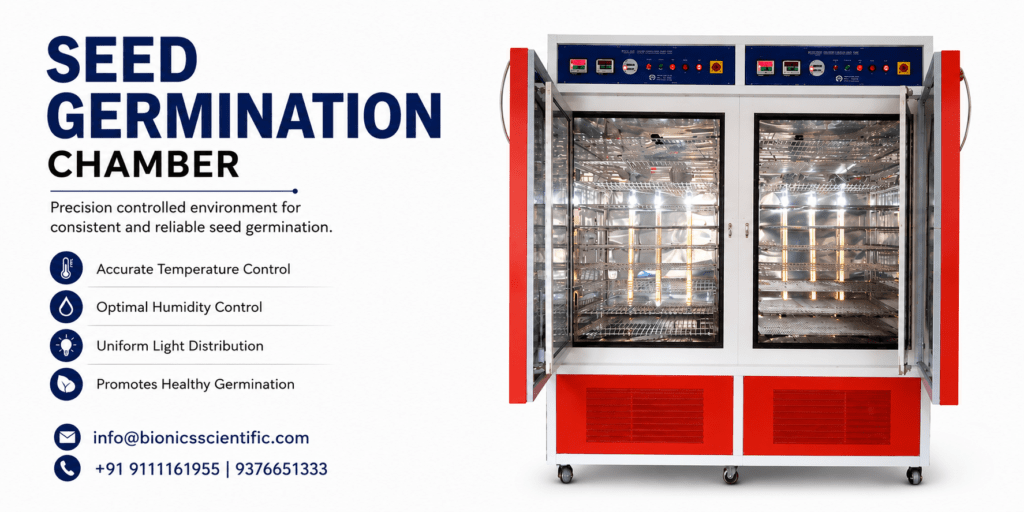
Laboratory apparatus for seed germination experiments Bionics Scientific Technologies has a wide range of germination chambers, BOD incubators, and plant growth chambers for schools, universities, laboratories, and seed test centers.
Contact us today for the right laboratory apparatus for your needs.
Frequently Asked Questions
How long does it take for radish seeds to sprout?
Under laboratory conditions radish seeds normally sprout in 3-7 days.
What is the germination temperature of radish seeds?
A uniform and healthy germination should be obtained at a temperature of 20-25°C.
Why is the radish seed used so much in laboratory experiments?
They grow fast, are fun to watch, and yield repeatable results. They are useful for education and research purposes.
Write the percent germination formula.
Germination % = No. of seeds germinated x 100 / No. of seeds
Types of seed germination?
Germination is of two types: epigeal and hypogeal.
Do radish seeds require light to germinate?
No, they do not need light to germinate directly. Adequate moisture, oxygen, and temperatures of 20-25°C are enough for successful germination.
Why don’t some seeds germinate?
Poor seed quality, incorrect moisture, incorrect temperatures, lack of oxygen, or contamination can reduce the success of germination.
Radish seed germination.
Both are quick to germinate, but the bean seeds have a different seed structure and seedling development than the radish seeds.
The laboratory equipment used for the seed germination experiment is:
Accurate seed germination experiments are usually conducted using Petri dishes, filter paper, laboratory incubators, germination chambers, scales, thermometers, and observation tools.